Why does the Fixed Point Iterative Method Work ?
We can try to understand why we converge to the right solution by examining the behaviour of the iterative method near the solution. Suppose the correct solution to the equation  is x = xs , i.e., is x = xs , i.e.,

Suppose the value of x at the kth iteration is near the solution xs and differs from it by a small amount Dxk, i.e.,

then:

which yields :
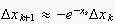
therefore if at k=0, x = xinit then,

Since:

Therefore as k tends to infinity, Dxk tends to zero. This means that if we start close enough to the solution, we will converge to the correct solution after many iterations, i.e., xk = xs if k is large. We say that the solution has converged if :

where e is the desired tolerance. The convergence is affected by the properties of the function at the solution point. You can check that if we wish to find out the solution of :

by the iterative algorithm:

the solution will diverge for any value of the initial guess which is not the true solution (x = 1).
What happens if we formulate the iterative algorithm for the same equation as follows ?

|


