
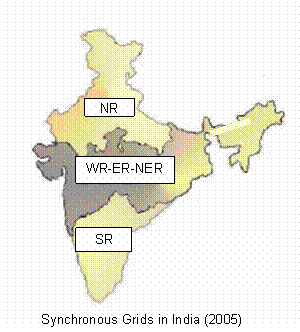
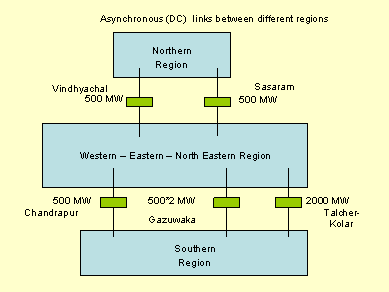
As mentioned in the first Module, the Indian Power System is made of 3 synchronous grids, the Northern Region, Western-Eastern-North Eastern Region (W-E-NE R), and the Southern Grid. The installed capacity is greater than 110 GW and a demand of 70 GW is met (2005). The synchronous regions are interconnected by asynchronous (HVDC) ties. Therefore, it is possible to operate the three grids independently since the power through the HVDC links can be independently controlled.
All DC links as shown in the figure are back to back, except for the one at Talcher-Kolar, which is a long HVDC line. Most of the power generation is likely to come up in the coal rich central-eastern region and the hydro-potential rich north eastern region. Therefore adequate capacity transmission is necessary to transmit this power to the load centres. Plan for a National Grid The plan for formation of national grid includes synchronous interconnection of the Northern Region with the W-E-NE-Region around 2006. Synchronous operation will allow for subsequent interconnection at several other locations using AC lines, thereby increasing the power exchanges between regions. Of course, one may increase the number and capacity of asynhronous links and achieve the same thing. Eventually, it is a tradeoff between the technical considerations and costs. What are the challenges in the integration of 2 large systems synchronously ? Among the problems which one will encounter are control of power flows between the interconnected regions and ensuring the maintainance of synchronism between interconnected generators subsequent to disturbances. |
 |
 |