| 35.3 |
Full Cycle Recursive DFT (contd..) |
|
|
| |
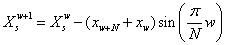
Eqns. 12 and 13 provide a recursive update for DFT computation. The advantage of recursive form is that it reduces computation from 2N multiply add operation in normal DFT to 4 additions and 2 multiplications. |
| |
To begin with, we will get 2N set  . When the first window is full populated with N-samples, we will get correct values of . When the first window is full populated with N-samples, we will get correct values of  and and  . Afterwards, for a stationary phasor at fundamental frequency . Afterwards, for a stationary phasor at fundamental frequency  and hence, the DFT latches on to the appropriate phasor. and hence, the DFT latches on to the appropriate phasor. |
| 35.4 |
Half Cycle DFT Form for Phase Estimation |
|
|
| |
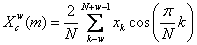
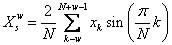
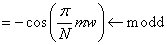
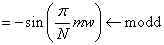
If our primary interest is to extract fundamental phasor component in the signal then, it can be verified that, restricting moving window to half a cycle does not alter the end result of eqn. (5) and (6) provided that N-now represents, number of samples per half-cycle. Now, the sample  is given by is given by 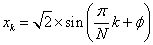 . Thus, half cycle form of DFT phasor estimation is given by the following eqns. . Thus, half cycle form of DFT phasor estimation is given by the following eqns. |
| |
Advantage of half cycle algorithm is that the moving window latches on to the post fault signal in  of a cycle. Thus, compared to full cycle version, it is twice as fast. A keen observer would have noticed that DFT based on moving window phasor estimation equations are identical to the full cycle and cycle fourier algorithms derived in lecture-31. Thus, the frequency response of fourier algorithms developed in lecture 31 applies to the DFT version. In particular, it is not surprising to see that harmonic rejection property of half cycle algorithm is inferior to its full cycle avatar. This is consistent with the ‘speed vs accuracy' conflict, we have discussed earlier. of a cycle. Thus, compared to full cycle version, it is twice as fast. A keen observer would have noticed that DFT based on moving window phasor estimation equations are identical to the full cycle and cycle fourier algorithms derived in lecture-31. Thus, the frequency response of fourier algorithms developed in lecture 31 applies to the DFT version. In particular, it is not surprising to see that harmonic rejection property of half cycle algorithm is inferior to its full cycle avatar. This is consistent with the ‘speed vs accuracy' conflict, we have discussed earlier. |
| |
Recursive form of half cycle DFT can be derived in an analogous manner to full cycle DFT. Realizing that |
| |
we get the following recursive update forms for fundamental phasor computation. |