| |
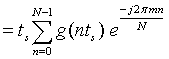
Since, we have N-data points [real] and  a complex number contains both magnitude and phase angle information in the frequency domain (2-units of information), it is reasonable to expect that we should be in a position to predict atmost a complex number contains both magnitude and phase angle information in the frequency domain (2-units of information), it is reasonable to expect that we should be in a position to predict atmost  transforms for original signal. transforms for original signal. |
| |
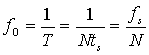
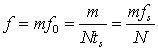
then substituting (3) in (1), we get |
| |
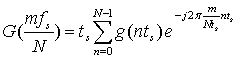
Note that our choice of frequency is such that the exponential term in (1) is independent of  . The intuition for choosing such . The intuition for choosing such  is that, in principles we are attempting a transform on discrete samples which may (or) may not have a corresponding analog ‘parent' signal. This suggests to us the following discrete version of Fourier transform for a finite discrete sequence is that, in principles we are attempting a transform on discrete samples which may (or) may not have a corresponding analog ‘parent' signal. This suggests to us the following discrete version of Fourier transform for a finite discrete sequence 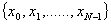 |