| |
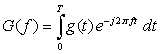
Then the Fourier transform of signal is given by: |
| |
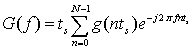
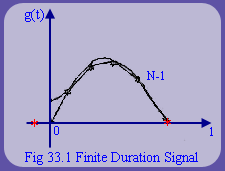
If we now evaluate the above integral by trapezoidal rule of integration after padding two zeros (red dots in fig 33.1) at the extremity on either side [where the signal is zero], we obtain the following expressions. |
| |
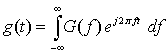
The corresponding inverse which is used to reconstruct the signal is given by:
|
| |
 |
If from equation (1) we could compute complete frequency spectrum i.e.  then (2) would imply that we can obtain then (2) would imply that we can obtain  . The fallacy in the above statement is quite obvious as we have only finite samples and the curve connecting any 2-samples can be defined plausibly in infinitely many ways (see fig 33.2). This suggests that from (1), we should be able to derive only limited amount of frequency domain information. . The fallacy in the above statement is quite obvious as we have only finite samples and the curve connecting any 2-samples can be defined plausibly in infinitely many ways (see fig 33.2). This suggests that from (1), we should be able to derive only limited amount of frequency domain information. |

 of duration
  sampled at (fig 33.1) a uniform rate
  such that
  where
where  is an integer
  .
.