| |
Lotus
|
|
|
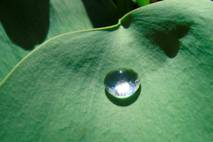
Plate 6A Water droplet on leaf |
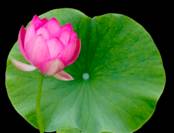
6B Lotus flower and leaf |
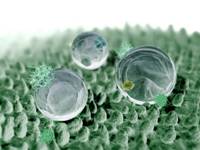
6C Tiny points on Lotus leaf surface |
(Source:https://www.google.co.in/search?hl=en&biw=1350&bih=602&q=lotus+flower+and+leaf&bav=
on.2,or.r_gc.r_pw.r_qf.&bpcl=37189454&um=1&ie=UTF8&tbm=isch&source=og&sa=N&tab=wi&ei=O
Y6XUPecGoXnrAeDp4CACw#um=1&hl=en&tbm=isch&sa=1&q=Droplet+on+lotus+leaf&oq=Droplet+
on+lotus+leaf&gs_l=img.12...374.11964.0.14358.14.13.1.0.0.0.1670.9234.42j5j2j2j1.12.0...0.0...1c.1.A
i2KRm6OY9g&pbx=1&bav=on.2,or.r_gc.r_pw.r_qf.&fp=ee4061bf378a508e&bpcl=37189454&biw=1350
&bih=602 ; Nov.5, 2012)
Lotus in India is widely seen and used in rituals. In Indian civilization, the freshness of lotus flower (plate 6B) that blooms out of mud yet mud does not touch it has inspired philosophically, metaphorically and in literature for years. The metaphorical and religious connotation of lotus flower’s character has always remained important in Oriental and Indian cultures. It has always amazed people to seeing how water never sticks to the leaf surface (plate 6A). The scientific study of the structure of the lotus leaf (plate 6C) has revealed fascinating facts that has inspired designers for innovations.
“On the lotus leaf (widely quoted as an example in nano-science circles) the waxy "nano-rough" surface structure of the leaf creates a vast number of hydrophobic (water repelling) contact points with water droplets on the leaf.”
(Read more: http://en.wikipedia.org/wiki/Lotus_effect ; Nov. 5, 2012) |