| |
Observation of Morpho (plate 2B &C) butterflies a Japanese company has already developed pigments based on the scientific studies of the color structure. The pigment has effected in energy consumption and industrial waste. Observation of such paradigm and innovative design may contribute in energy saving and waste management both are directly related to India’s economy and environment. Based on such research (nanotechnology) and the cost involved it may not be applicable in macro level, however it could be applied in very specific fields (medical, defence, etc.).
“Teijin Fibers Limited of Japan produces Morphotex® fibers…. No dyes or pigments are used. Rather, color is created based on the varying thickness and structure of the fibers. Energy consumption and industrial waste are reduced because no dye process must be used.”
(Ref.http://www.asknature.org/product/4c0e62f66bcccabf55a1f189da30acb3 ; Nov. 5, 2012)
“Structural color is caused by wavelength-selective scattering of light by microscopic features, such as those on the scales of some insects. The brilliant blue displayed by some male Morpho butterflies is a classic example of this phenomenon. In this paper, experiments used to distinguish structural color from color due to pigmentation are reviewed. A simple electromagnetic model is developed for the structural scattering from Morpho butterfly scales, and the blue color and iridescence normally seen for these butterflies are predicted by this model. The analysis is based on topics usually discussed in courses on electromagnetism and optics and can be used as an example to supplement classroom discussions of these topics.” (Ref. ‘Structural color of Morpho butterflies’; American Journal of Physics, Volume 77, Issue 11, pp. 1010-1019 (2009)http://adsabs.harvard.edu/abs/2009AmJPh..77.1010S ; Nov. 5, 2012)
Animal
|
|
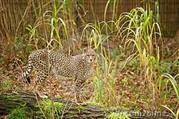
Plate 3A Cheetah hiding in grass |
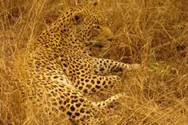
3B Spotted Leopard |
|