The structural color of the feather is responsible for the colors of many birds, as well as certain butterfly wings and beetle shells. Variations in the spacing of the pattern often giverise to achangeable effect, as seen in butterfly wings (plate 1C) andpeacockfeathersbecause the reflected color depends upon the angle of view. The deceptive coloration in nature’s design (read more: http://www.nhptv.org/natureworks/nwep2a.htm ; Nov. 5, 2012) has always amazed mankind to learn and mimic for their safety and comfort.
Following are some of the unique examples in nature that have taught us various concepts-
Butterfly
|
|
|
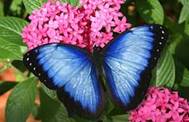
Plate 2A Morpho Butterfly
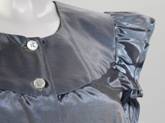
(Morphotex® fibers, Japan)
|
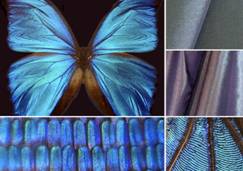
2B Color Structure of Morpho |
2C Fabric Design |
(Source:https://www.google.co.in/search?hl=en&q=structural+color+of+morpho+butterflies&bav=on.2,
or.r_gc.r_pw.r_qf.&bpcl=37189454&biw=1350&bih=602&um=1&ie=UTF-8&tbm=isch&source=og&sa=
N&tab=wi&ei=sFaXUKcyxrysB_izgKgE ; Nov. 5, 2012
Read more: http://www.nhptv.org/natureworks/nwep2a.htm ; Nov. 5, 2012;
Read more: http://www.webexhibits.org/causesofcolor/15A.html ; Nov. 5, 2012)
Butterflies (plate 2A) have fascinated humankind forever.We have interpreted in a variety of ways metaphorically and in personal level. Hardly have we realized the delicate intricate structure and functional beauty of changeable colors of the wings to foil the predators. The structural colors are created through an optical effect (such as interference, refraction, or diffraction) rather than by a pigment. They arise from the arrangement of physical structures interacting with light to produce a particular color.Morpho Butterflies (plate 2A) remain a bright and striking blue throughout their lives. “The scales on their wings are made of many layers of proteins that refract light (plate 2B) in different ways, and the color we see often is due entirely to the play of light and structure rather than the presence of pigments.”
(Ref.http://www.asknature.org/product/4c0e62f66bcccabf55a1f189da30acb3 ; Nov. 5, 2012) |