|
Lecture-4
Depth Perception through Linear or one point Perspective:
When we see object in distance from a particular angle, sometimes we see it as an illusion to know how we must know about perspective and its principles. There are three types of perspective generally we encountered with while looking at objects from distances apart from what we discussed earlier. These are one point perspective, two point perspective and three point perspective.
Linear or one point Perspective : Linear perspective refers to the fact that parallel lines, such as railroad tracks, appear to converge with distance, eventually reaching a vanishing point on the horizon. The more the lines converge, the farther away they appear. One vanishing point is typically used for roads, railway tracks, hallways, or buildings viewed so that the front is directly facing the viewer as shown in Fig.35. Any objects that are made up of lines either directly parallel with the viewer's line of sight or directly perpendicular (the railroad slats) can be represented with one-point perspective.
One-point perspective exists when the picture plane is parallel to two axes of a rectilinear plane — a plane which is composed entirely of linear elements that intersect only at right angles. If one axis is parallel with the picture plane, then all elements are either parallel to the ground plane or level (either horizontally or vertically) or perpendicular to it. All elements that are parallel to the ground plane are drawn as parallel lines. Elements that are perpendicular to the ground plane converge at a single point (a vanishing point) on the horizon. A typical example of one-point perspective is shown in Fig.35.
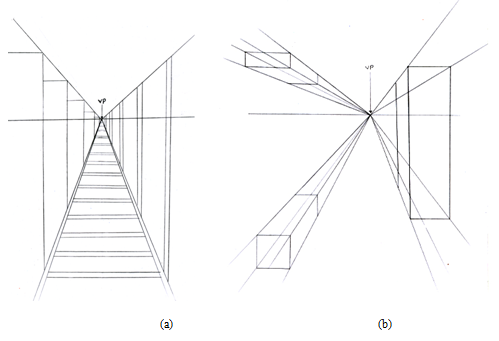
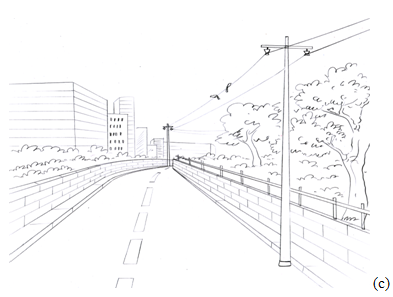
Fig. 35a, b and c: An example of linear or one point perspective
|
