Symmetric:
Let a , b ∈ G. Since a ≡ b mod H
a ⊕ b -1 ∈ H
⇒ ( a ⊕ b -1 ) -1∈ H [Since H is a subgroup]
⇒ ( b -1 ) -1 ⊕ a -1 ∈ H
⇒ b ≡ a mod H
Transitive:
Let a , b , c ∈ G Λ a = b mod H Λ b ≡ c mod H
a ⊕ b -1 ∈ H Λ b ⊕ c -1∈ H
So a ⊕ b -1 ⊕ b ⊕ c -1∈ H
⇒ a ⊕ c -1 ∈ H
⇒ a ≡ c mod H

Cosets: Let (G, ⊕ ) be a group and H is a subgroup of G .Pick an element a belonging to G.
Let H a = { h ⊕ a | h ∈ H} be Right coset
Let a H= { a ⊕ h | h ∈ H} be Left coset
Lemma 2: H a = { x | x ≡ a mod H} ∀a ∈ G
Proof: Let [ a ] = { x | x ≡ a mod H}. We have to show H a =[ a ].
To prove H a ⊆ [ a ] let us pick an element h ⊕ a ∈ H a . Thus ∀ h∈ H a ⊕ ( h ⊕ a ) -1 = a ⊕a -1 ⊕ h -1 = h -1 ∈H [Since H is a subgroup].
⇒ h ⊕ a ∈[a]
To prove that [ a ]⊆ H a let us pick an element x ∈[ a ]
⇒ a ⊕ x -1 ∈ H
⇒ ( a ⊕ x -1 ) -1∈ H
⇒ x ⊕ a -1 ∈ H
Therefore for some h ∈H we have x = h ⊕ a . Thus x ∈ H a and [a]⊆ Ha.
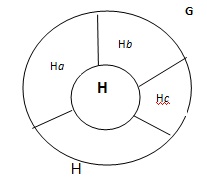
Lemma 3: There is a one to one correspondence between any 2 right cosets of G.