Total Suction Measurement
Most of the measurement techniques for total suction measurement are based on
(i) measuring RH and then relating to total suction
(ii) controlling RH and measuring moisture content for obtaining total suction
The above described techniques are based on the following Kelvin's equation which relates relative humidity and porewater potential as
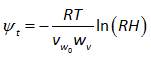 ...........................................................................(4.2)
where R is the universal gas constant (8.314 J/mol.K), T is absolute temperature (K), Vwo is the specific volume of water or inverse of the density of water (m3/kg), wv is the molecular mass of water vapor (18.016 kg/kmol), and RH is the relative humidity . This equation considers the effect due to all the mechanisms that decrease the chemical potential of water. Thus, the equation is applicable to study the total suction. The following figure (Fig. #) shows the variation of total suction with RH at T= 293.16 K using the Kelvin's equation. The advantage of the Kelvin's formula is that the total suction can be indirectly measured by establishing the equilibrium between relative humidity of the pore water for an unsaturated soil specimen with the controlled ambient atmosphere. The total suction is zero when the RH of the pore water vapor is 100%. The RH value less than its full saturation (RH < 100%) indicates the reduction in the pore water potential in soils and, thus, the presence of negative pressure in the soil pore water.