Density of Water
The density of water can directly influence the physical and mechanical behavior of unsaturated soils beacuse many unsaturated soil parameters depend on the water density. The density of water, in-turn, is a function of temperature as shown in Fig. 2.8. Most materials (like mercury, Gold, etc.) decrease their volume consistently when the temperature decreases. Nevertheless, when water is cooled down steadily from its boiling point, the volume decreases up to 4°C and then water expands until it freezes. The freezing point temperature for water is 0°C where water undergoes phase transformation from liquid to solid. As ice starts to melt upon heating, some of the hydrogen bonds break, and water molecules can slide closer together when compared to its solid state, i.e. ice. The ice is about 10% less denser than cold water at 4°C. The volume expansion of water below 4°C temperature is called anamoulous expansion of water. Such expansion causes bursting of frozen pipes and frostbites on human skin in the cold countries. Therefore, the density of water increases up to 4°C and then decreases below this temperature as shown in Fig. 2.8. The ice (< 4°C) can float on water due to these consequences. The ice displaces more water volume than its weight. Moreover, the conduction of heat is dependent on the density of the substance. A material with less dense conducts less heat than the denser material/substance. Therefore, when the lakes freeze with the formation of ice (which floats on the surface due to less density than the water) conducts less heat through it helping the deeper layers of water to maintain warm temperatures beneath the ice sheet. The aquatic life survives because of this peculiar and anomalous expansion of the water in the cold places as illustrated in Fig. 2.9. If the water had to behave similar to other substances, all water bodies including the ocean would freeze solid during the winters and only the upper layers of the ocean would thaw during the summer.
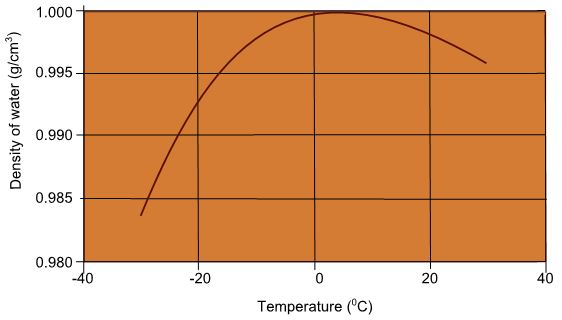
Fig. 2.8. Dependency of water density on temperature