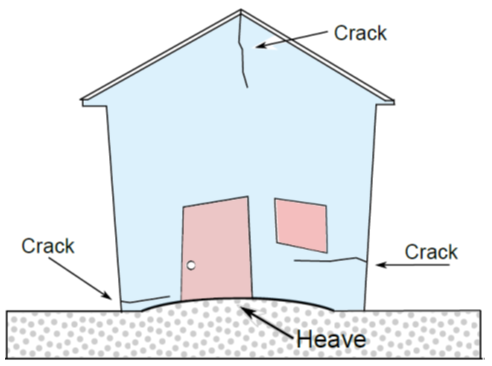
Fig. 1.12. Illustration of damaged buildings constructed on expansive clays
The presence of expansive clays reflects the environment, as they are usually associated with semiarid and arid climates, mineral composition containing significant amounts of smectite group minerals. Most expansive clay deposits in India and elsewhere are either residual soils formed from igneous/montomorillonitic rocks or sedimentary deposits. These clays contain high percentages of montomorillonite minerals. The swelling in montomorillonitic soils is due to the chemical attraction of water into crystal lattice of clay minerals. Layers of water molecules diffuse between the flat and submicroscopic clay platelets. Different mechanisms involved in swelling phenomena in clays are described below as reported by Popescu (1986):
(i) Interparticle or intercrystalline swelling: In a residual or pendular regime where the soil remains nearly dry, particles are held together under capillary tensile stresses. These stresses are relaxed upon wetting that encourages the expansion of clay as shown in the Fig 1.13a.
(ii) Intracrystalline swelling: This swelling mechanism is primarily a characteristic of montmorillonite group of minerals. The layers of crystals in montmorillonite are weakly bonded. The water enters, upon wetting, not only between crystals, but also between the individual layers of single crystal as shown in Fig 1.13b. The increase in the water content also increases thickness of diffuse double layers (water layer around the particles) of the clay platelets and manifests in the form of swelling.