| DYMAMICS OF FLUID FLOW | |||||
Loss of Energy at the Exit from a Pipe |
|||||
The outlet end of a pipe carrying liquid may be either left free or connected to a large reservoir. The liquid leaving the pipe possesses some kinetic energy corresponding to the velocity of the flow in the pipe which is ultimately dissipated either in the form of free jet or turbulence in the reservoir depending on the outlet condition in the pipe. The loss may be determined by using Eq. (6) with the conditions for which Loss of Energy due to Obstruction in Flow Passage The loss of energy due to flow obstruction in a pipe occurs due to the sudden reduction in the cross-sectional area followed by an abrupt enlargement of the stream beyond the obstruction (Fig. 3). Consider a pipe flow (cross-sectional area of the pipe is A) in which an obstruction is placed with maximum cross-sectional area a. As the flow passage is reduced to (A-a), a vena-contracta is formed beyond which the flow becomes uniform after certain distance from vena-contracta. If Vc and V be the velocities at vena-contracta and at some section (where the flow is uniform), then the loss of head due to obstruction can be deduced from Eq. (6) i.e. |
|||||
| Prev | |||||
 . So, the loss of head at the exit of the pipe is equal to
 , where
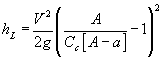 (7)