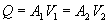
| DYMAMICS OF FLUID FLOW | |||||
Loss of Energy due to Sudden Enlargement |
|||||
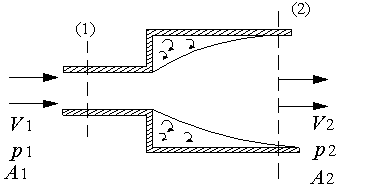
Consider a pipe of cross-sectional area A1and carrying a liquid of specific weight |
|||||
| Prev | |||||
| DYMAMICS OF FLUID FLOW | |||||
Loss of Energy due to Sudden Enlargement |
|||||
Consider a pipe of cross-sectional area A1and carrying a liquid of specific weight |
|||||
| Prev | |||||
 . It is connected to another pipe of larger cross-sectional area