Lognormal distribution
It shows the outcome of single tailed experiment. Any real valued function whose logarithm is normally distributed, the function follows log normal distribution.

Evaluation of probabilities associated with the lognormal distribution is simple due to its relation with the normal distribution. If the probability of a lognormal variable falling between a and b is to be found, the standard normal tables can be utilized in the following manner;

By replacing {In x-μ)/σ} with z, the above integral results in the following form;
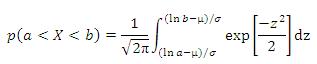
The above integral can be easily evaluated using the areas under the standard normal curves corresponding to the two limits obtained from the standard normal tables. This distribution is useful in analyzing the processes where the outcomes are always positive. For example, the rain fall intensity, air traffic, suspended particulate matter in the ambient atmosphere, and the material strength characteristics are the processes where the outcome is always greater than or equals to zero. Figure 5.13 shows the probability density functions of the lognormal random variable corresponding to various parameters. Figure 5.14 shows the frequency distribution of the runoff data and the corresponding theoretical lognormal distribution. From this figure it can be seen that the lognormal distribution is closely approximating the runoff data.
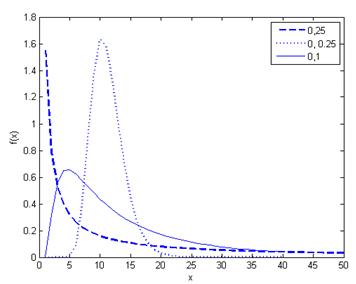
Figure 5.13: Lognormal distributions resulting from various combinations of means and variances of logX
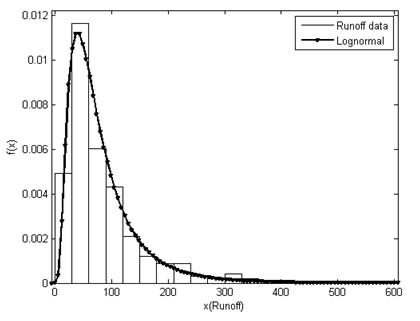
Figure 5.14: Runoff data modeling using lognormal distribution
Mean and the Variance of the Lognormal Distribution
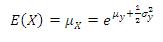
A random variable X with range space RX = {x:0 < x < ∞} is considered where Y=ln X is normally distributed with mean μy and variance σy2 .
Mean
Variance

Similar to the additive reproductive property of the normal distribution, this has the multiplicative reproductive property. If any two random variables X1 and X2 follow lognormal distribution with means μ1 , μ2 and the variances σ12 , σ22 respectively, the resulting variable from the multiplication of these two variables follow lognormal distribution with parameters μ1 +μ2 and σ12 +σ22 .