One of the primary objectives of a groundwater management model is to know the maximum possible withdrawn that can be obtained from an aquifer. In this lecture, we will find out the maximum possible withdrawal from a confined aquifer while maintaining drawdown at certain specified level. Consider the aquifer shown in Fig. 25.1 below.
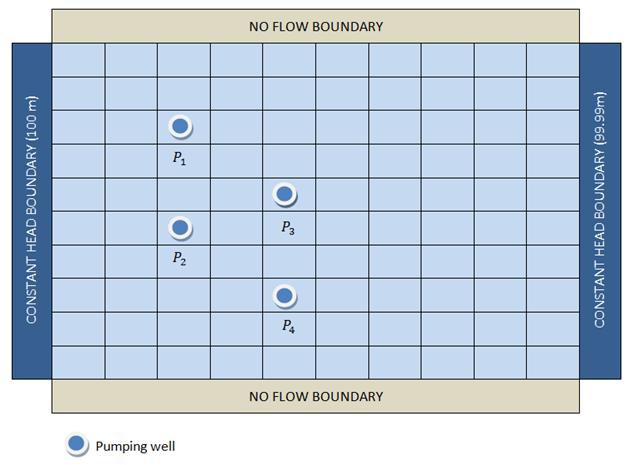 |
Fig. 25 .1 Confined aquifer with pumping well locations |
The main objective of the problem is to obtain maximum possible discharge from the pumping wells while maintaining drawdown at certain level. The optimization model can be formulated as,
| Minimize | 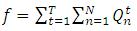 |
( 25 .1) |
Subject to
 |
( 25 .2) |
Where T is the total number of time steps, N is the total number of pumping and Qni is the pumping rate at time t for the well n, l is the total number of grids in x direction, j is the total number of grids in y direction, hti,j is the head value at location (i, j) at time t. The management problem can be solved using simulation-optimization methodology. In this methodology, the simulation model is linked externally with the optimization model. In every iteration of the optimization model, the simulation model is called to get the information about spatial and temporal distribution of hydraulic heads in the aquifer. The spatial and temporal distribution of head values is required to obtain the constraints information, i.e. , the equation (25.2). The methodology is shown in Fig. (25.2).