3.4 Design of landfills
An engineered landfill essentially consists of a barrier layer or liner which is a low permeable zone to prevent the leaching of waste from the landfill. Above the liner, a drainage layer is placed which collects the leachate from the waste for treatment. Such a layer also minimizes the head causing flow in liner due to the timely removal of leachate from the landfill. The third important layer is the cover to the landfill, which is a multi-layered system to cut off the harmful effect of waste on the atmosphere. The various aspects required for planning and design of landfill are as follows:
- Waste Characterization
- Assessment of leachate and gas generation
- Landfill elements to be provided
- Liner and cover materials
- Landfill design approach
3.4.1 Waste Characterization:
Waste characterization is important to understand the following:
- Physical and chemical tests are preformed to evaluate whether waste is hazardous or non-hazardous.
- Whether waste can be landfilled directly or necessitate processing (reduction, recycling etc.) before disposal.
- Approximate rate of waste volume generated.
- Assessment of leachate quantity.
- Assessment of leachate quality for judging liner compatibility, treatment plant design, ground water monitoring program design.
- Safety precautions to be followed during landfill operations.
- Identify waste reduction alternatives.
3.4.2 Assessment of leachate and gas generation
Leachates are produced when water or other liquids percolates and interacts with waste. The information on quality and quantity of leachate and gas generated during active life and after closure are important for realistic and efficient design of a landfill. Leachate contains a lot of dissolved and suspended materials. Gases produced include CH4, CO2, NH3 and H2S due to anaerobic decomposition of waste. These gases either escape to atmosphere or dissolve in water leading to further reactions. Contaminated liquids of high concentration are formed due to chemical reaction taking place within the waste. The percolating water increases the quantity of leachate but would help to dilute the concentration.
Factors influencing leachate quality
a) Refuse composition
b) Elapsed time:
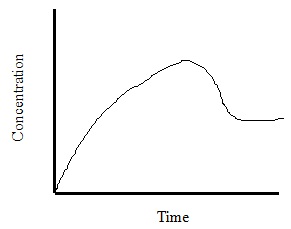
Leachate quality (concentration) increases and reaches peak during the working period of landfill and then start decreasing with time as shown in Fig. 3.5. All the contaminants present in the leachate do not exhibit peak at the same time and may not be of same shape.
|
| Fig. 3.5 Variation of leachate quality (concentration) with elapsed time |
c) Temperature:
Temperature affects bacterial growth and chemical reactions, there by affecting leachate quality.
d) Available moisture influences biodegradable and subsequent leaching of wastes.
e) Available oxygen influences leachate quality due to the fact that chemicals released due to aerobic decomposition is different from anaerobic decomposition. Anaerobic condition would arise due to landfill cover or covering due to fresh waste.