3.2 Landfills
There are two types of landfills namely natural attenuation landfill and containment landfill as depicted in Fig. 3.3. Natural attenuation landfill is similar to what has been discussed in the previous paragraph where there is no provision below the wastes to minimize the migration of harmful contaminants. The unsaturated subsurface below the wastes naturally attenuate harmful contaminants before it reaches ground water. It is presumed that the contaminants reaching ground water will be well within the permissible limit, even though in most of the cases it would not be. For the same reason, these types of landfills are not preferred in spite of its simplicity.
In the containment landfill, there is an engineered layer of soil known as liner on which the waste is disposed or dumped. Soil liners are constructed with some desirable properties meeting the regulations set by the pollution control board. The design of these liners is done in such a way that the contaminants leaching out seeps at a very low pace and gets attenuated. The concentration of contaminants reaching the ground water within the prescribed design life is expected to be well within the permissible limit. This type of landfill is mandatory for containing hazardous wastes such as industrial and nuclear wastes. All the working elements of such landfills are properly designed. This module essentially deals with the role of geoenvironmental engineers in deciding and designing engineered containment landfills.
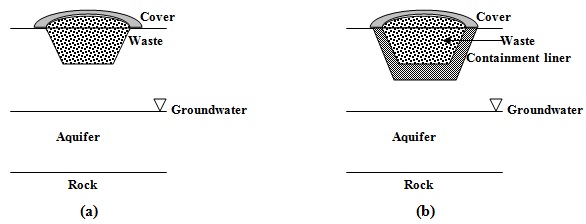 |
Fig. 3.3 Conceptual depiction of types of landfill (a) Natural attenuation (b) Containment |
3.2.1 Engineered landfills
The first and foremost task in the planning of engineered landfills is its site selection. There are several socio-economic concerns which need to be satisfied before a site can be decided for waste disposal. The major concern is social since nobody likes wastes to be dumped in their neighbourhood. This would necessitate mass education and awareness program on the pros and cons of the waste management project. Apart from public acceptance the other factors which are important in site selection are locational, geotechnical and hydrogeological criteria. Another important aspect in landfill site selection is establishing search radius, which is the maximum distance of waste hauling (transport). Waste hauling is one of the costliest items in landfill operations. Three important steps of landfill site selection are
- Data collection
- Locational criterion
- Obtaining public reaction and acceptance
a) Data collection: The data pertained to landfill site selection are summarized as follows:
i) Topographic maps: This include information on contour, natural surface, water drainage, location of streams, wetlands etc. Ideally landfills should be avoided on land contributing to groundwater recharge. The surface flow should be in such a way that water flow away from the landfill site. In case the flow is towards the landfill then adequate measure has to be taken to prevent excessive water seeping into the landfill.