Putting the expressions of BV n-1 in equation (4.1) results in;

On simplifying the above expression;
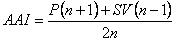 ---------------------------------------------(4.2)
It may be noted here that while calculating average annual investment (AAI) for equipments mounted on pneumatic tires using the equation (4.2), cost of pneumatic tires is subtracted from initial cost of the equipment. The annual interest cost or cost of capital investment annual can be calculated by multiplying the average annual investment (AAI) as mentioned in equation (4.2) by the annual interest rate or rate of return.
d) Taxes
It represents the property taxes to be paid to the state or central government. It depends on the value of the equipment owned and the applicable tax rate for a given location. The property tax can be calculated as a percentage of the average annual investment or a percentage of the book value in a given year. Generally it ranges from 2 to 5% of the average annual investment or book value of equipment.
e) Insurance cost
It represents the annual premium to be paid to insurance companies to cover the cost incurred due to accident, fire, theft etc. for the construction equipment. In other words, it represents the cost that protects the owner of the equipment against these damages. Similar to taxes, the insurance cost can be calculated as a percentage of the average annual investment or the book value in a given year. It is generally about 1 to 3% of the average annual investment or book value of equipment.
f) Storage cost
It is the cost of keeping the equipment in storage yards when it is not operating at the work site. Storage cost includes the rental and maintenance charge for storage yards, wages of security guards and wages of workers employed for bringing in and out of the storage yards. It is around 0.5 to 1.5% of the average annual investment or book value of equipment. The annual storage cost can be calculated for the entire fleet of equipment and is then prorated to individual equipment requiring the storage facility.
Similar to storage cost, the tax and insurance cost can be calculated for the equipment fleet and then prorated to individual equipment. It may be noted here that the annual rates (%) mentioned above for taxes, insurance and storage costs are typical values. However the actual rates will vary depending on the type and size of equipment, place of purchase, location of project site etc.
After calculating the different components, the total annual ownership cost of the construction equipment is calculated by summing up depreciation cost, investment (or interest) cost, tax, insurance and storage costs. Then the hourly cost of ownership can be calculated by dividing the annual ownership cost by the number of operating hours the equipment will operate annually. The hourly ownership cost can also be calculated by first determining the components of ownership cost individually on hourly basis followed by adding these hourly costs to get the total hourly ownership cost.