Inflation:
Inflation is defined as an increase in the amount of money required to purchase or acquire the same amount of products and services that was acquired without its effect. Inflation results in a reduction in the purchasing power of the monetary unit. In other words, when prices of the products and services increase, we buy less quantity with same amount of money i.e. the value of money is decreased. For example, the quantity of items we purchase today at a cost of Rs.1000 is less than that was purchased 5 years ago. This is due to a general change (increase) in the price of the goods and services with passage of time. On the other hand deflation results in an increase in the purchasing power of the monetary unit with time and it rarely occurs. Due to effect of deflation, more can be purchased with same amount of money in future time period than that can be purchased today. The inflation rate (f) is measured as the rate of increase (per time period) in the amount of money required to obtain same amount of products and services. Till now, the interest rate ‘i' that was used in the economic evaluation of a single alternative or between alternatives by different methods as mentioned in earlier lectures was assumed to be inflation-free i.e. the effect of inflation on interest rate was excluded. This interest rate ‘i' is also known as also real interest rate or inflation-free interest rate. It represents the real gain in money of the cash flows with time without the effect of inflation. However if inflation is there in the general market, then effect of inflation on the interest rate needs to be taken into account for the economic analysis. The interest rate that includes the effect of price inflation which is occurring in general economy is known as the market interest rate (ic). It takes into account the adjustment for the price inflation in the market. Market interest rate is also known as inflated interest rate or combined interest rate as it combines the effect of both real interest rate and the inflation.
In addition to above parameters, it is also required to define two parameters namely actual monetary units and constant value monetary units while considering the effect of inflation in the cash flow of the alternatives. The monetary units can be Rupees, Dollars, Euros etc. The actual monetary units are also referred as future or inflated monetary units. The purchasing power of the actual monetary units includes the effect of inflation on the cash flows at the time it occurs. The constant value monetary units are also called as real or inflation-free monetary units. The constant value monetary units are expressed in terms of the same purchasing power for the cash flows with reference to a base period. Mostly in engineering economic studies, the base period is taken as ‘0' i.e. now. But it can be of any time period as required.
The effect of inflation on cash flows is demonstrated in the following example.
Example -5
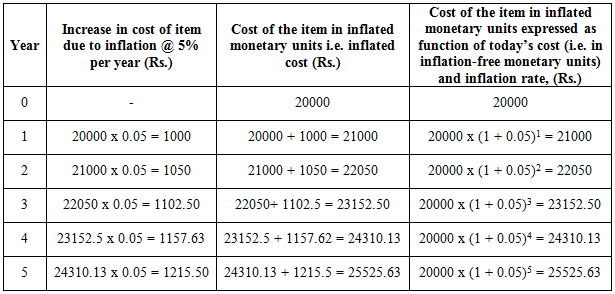
The present (today's) cost of an item is Rs.20000. The inflation rate is 5% per year. How does the inflation affect the cost of the item for the next five years?
Solution:
The calculations are shown in Table 3.7.
Table 3.7 Effect of inflation on future cost of the item