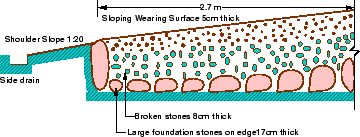
Figure 1:
French roads
 |
The next major development in the road construction occurred during the regime
of Napoleon.
The significant contributions were given by Tresaguet in 1764 and a typical
cross section of this road is given in Figure 1.
He developed a cheaper method of construction than the lavish and locally
unsuccessful revival of Roman practice.
The pavement used 200 mm pieces of quarried stone of a more compact form and
shaped such that they had at least one flat side which was placed on a compact
formation.
Smaller pieces of broken stones were then compacted into the spaces between
larger stones to provide a level surface.
Finally the running layer was made with a layer of 25 mm sized broken stone.
All this structure was placed in a trench in order to keep the running surface
level with the surrounding country side.
This created major drainage problems which were counteracted by making the
surface as impervious as possible, cambering the surface and providing deep
side ditches.
He gave much importance for drainage.
He also enunciated the necessity for continuous organized maintenance, instead
of intermittent repairs if the roads were to be kept usable all times.
For this he divided the roads between villages into sections of such length
that an entire road could be covered by maintenance men living nearby.
|
|

