Module 6 : Influence Lines
Lecture 5 : Müller-Breslau Principle
6.5

Müller-Breslau Principle


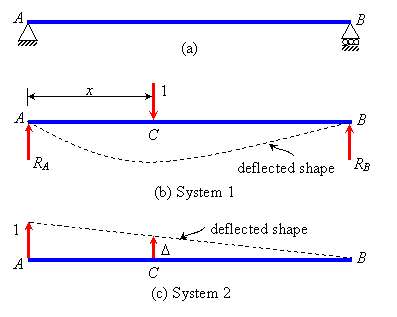
The Müller-Breslau principle uses Betti's law of virtual work to construct influence lines. To illustrate the method let us consider a structure AB (Figure 6.7a). Let us apply a unit downward force at a distance x from A , at point C . Let us assume that it creates the vertical reactions and at supports A and B , respectively (Figure 6.7b). Let us call this condition “System 1.” In “System 2” (figure 6.7c), we have the same structure with a unit deflection applied in the direction of . Here is the deflection at point C .


                              Figure 6.7 (a) Given system AB , (b) System 1, structure under a unit load,

 
                                                 (c) System 2, structure with a unit deflection corresponding to


According to Betti's law, the virtual work done by the forces in System 1 going through the corresponding displacements in System 2 should be equal to the virtual work done by the forces in System 2 going through the corresponding displacements in System 1. For these two systems, we can write:


The right side of this equation is zero, because in System 2 forces can exist only at the supports, corresponding to which the displacements in System 1 (at supports A and B ) are zero. The negative sign before accounts for the fact that it acts against the unit load in System 1. Solving this equation we get:


In other words, the reaction at support A due to a unit load at point C is equal to the displacement at point C when the structure is subjected to a unit displacement corresponding to the positive direction of support reaction at A . Similarly, we can place the unit load at any other point and obtain the support reaction due to that from System 2. Thus the deflection pattern in System 2 represents the influence line for .