| |
Maxwell-Betti Law of real work is a basic theorem in the structural analysis. Using this theorem, it will be established that the flexibility coefficients in compatibility equations, formulated to solve indeterminate structures by the flexibility method, form a symmetric matrix and this will reduce the number of deflection computations. The Maxwell-Betti law also has applications in the construction of influence lines diagrams for statically indeterminate structures. The Maxwell-Betti law, which applies to any stable elastic structure (a beam, truss, or frame, for example) on unyielding supports and at constant temperature, states: |
| |
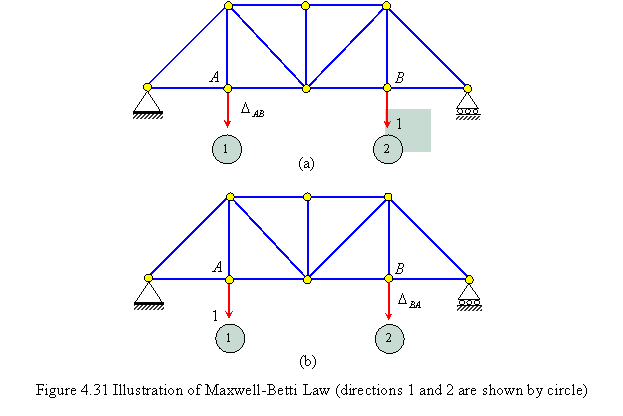
The deflection of point A in direction 1 due to unit load at point B in direction 2 is equal in the magnitude to the deflection of point B in direction 2 produced by a unit load applied at A in direction 1. |
| |
The Figure 4.31 explains the Maxwell-Betti Law of reciprocal displacements in which, the displacement
 is equal to the displacement is equal to the displacement  . .
|
| |
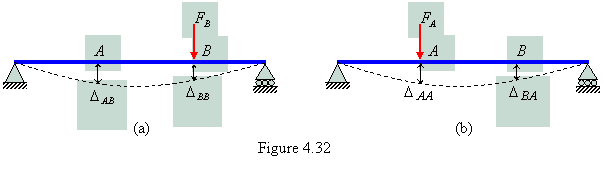
In order to prove the reciprocal theorem, consider the simple beams shown in Figure 4.32.
Let a vertical force  at point B produces a vertical deflection at point B produces a vertical deflection  at point A and at point A and  at point B as shown in Figure 4.32(a). Similarly, in Figure 4.32(b) the application of a vertical force at point B as shown in Figure 4.32(a). Similarly, in Figure 4.32(b) the application of a vertical force  at point A produces a vertical deflections at point A produces a vertical deflections  and and  at points A and B , respectively. Let us evaluate the total work done by the two forces at points A and B , respectively. Let us evaluate the total work done by the two forces  and and  when they are applied in different order to the zero to their final value. when they are applied in different order to the zero to their final value. |