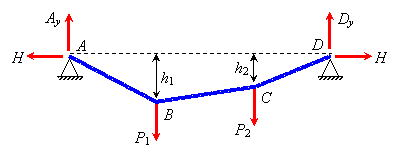
Cables are flexible wire-like systems having no flexural (bending) stiffness, and they can carry only axial tension and no other type of force. Being fully flexible against bending the shape of a cable is determined by the external forces that are acting on the cable. Figure 3.1 illustrates how the shape of the cable between two supports A and B depends on the location and magnitude of the external forces
and
.
Figure 3.1 Shape of a cable is determined by external loads
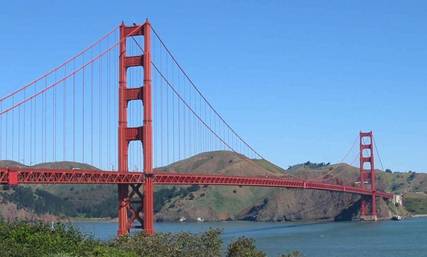
A cable is unable to carry bending moment, shear force, torsion or axial compression. Nevertheless, cables can be very effectively used in achieving long-span light-weight systems, such as bridges or roofs for large arenas. Two kinds of bridge structural systems where cables are used are the suspension-cable systems and cable-stayed systems . Figures 3.2 and 3.3 show examples of suspension-cable bridge and cable-stayed bridge, respectively.
Figure 3.2 A suspension-cable bridge (Golden gate bridge, San Francisco , USA)

 and
and
 .
.