| |
An indeterminate system is often described with the number of redundants it posses and this number is known as its degree of static indeterminacy . Thus, mathematically:
|
| |
Degree of static indeterminacy = Total number of unknown (external and internal) forces |
|
| |
- Number of independent equations of equilibrium
|
|
(1.21)
|
| |
It is very important to know exactly the number of unknown forces and the number of independent equilibrium equations. Let us investigate the determinacy/indeterminacy of a few two-dimensional pin-jointed truss systems. |
| |
Let m be the number of members in the truss system and n be the number of pin (hinge) joints connecting these members. Therefore, there will be m number of unknown internal forces (each is a two-force member) and 2 n numbers of independent joint equilibrium equations (  and and  for each joint, based on its free body diagram). If the support reactions involve r unknowns, then: for each joint, based on its free body diagram). If the support reactions involve r unknowns, then:
Total number of unknown forces = m + r
Total number of independent equilibrium equations = 2 n
So, degree of static indeterminacy = ( m + r )
- 2 n
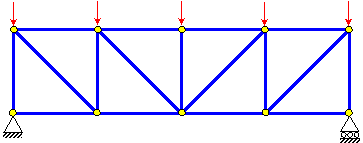
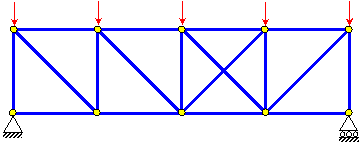
For the trusses in Figures 1.14a, b & c, we have: |
| |
Figure. 1.14a Determinate truss |
| |
1.14a: m = 17, n = 10, and r = 3. So, degree of static indeterminacy = 0, that means it is a statically determinate system.
|
| |
Figure 1.14b (Internally) indeterminate truss |
| |
1.14b: m = 18, n = 10, and r = 3. So, degree of static indeterminacy = 1. |