Right-turn signal phases facilitate right-turning traffic and may improve the
safety of the intersection for right-turning vehicles.
However, this is done at the expense of the amount of green time available for
through traffic and will usually reduce the capacity of the intersection.
Right-turn arrows also result in longer cycle lengths, which in turn have a
detrimental effect by increasing stops and delays.
While phases for protected right-turning vehicles are popular and commonly
requested, other methods of handling right-turn conflicts also need to be
considered.
Potential solutions may include prohibiting right-turns and geometric
improvements.
The three criteria for right -turn phase is presented below:
- Traffic Volumes
- Delay:
Separate right -turn phasing may be considered if the average delay for all
right-turning vehicles on the approach is at least 35 seconds during that same
peak hour.
- Collision Experience: Separate right -turn phasing may be considered if
the critical number of reportable right -turn collisions has occurred.
These are:
(i) For one approach to the intersection, the critical number is five l right
-turn collisions in one year, or seven in two years.
(ii) For both approaches to an intersection, the critical number is seven right
-turn collisions in one year, or eleven in two years.
So the right turning vehicles affected saturation flow based on adjusted
saturation headway.
Finally actual values of right turning are calculated from right turn
adjustment factor.
The adjustments factor is calculated by following equations.
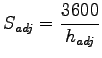
Adjusted saturation headway,
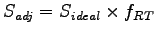
Adjusted saturation flow,
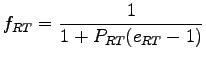
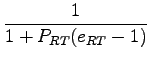
Multiplicative right turn adjustment factor,
If there is 15 percent right turning movement, eRT (through-car equivalent for
permitted left turns) is 3, saturation headway is 2 sec; Find the value of
Adjusted Saturation flow.
Given
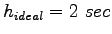 , ,
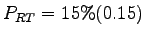 , ,
 , , 
Case 1:
Find adjusted saturation headway as:
Now, find adjusted saturation flow as:
 .
The adjusted saturation flow is 1385 vph. .
The adjusted saturation flow is 1385 vph.
Case 2
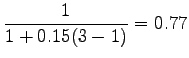
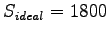
Find the adjustment factor to calculate adjusted saturation flow based on ideal
saturation flow (1800)
The adjusted saturation flow is 1386 vph.
The result is same from both cases.
Lft turn adjustment factor for saturation flow rate is as follows:
For exclusive lane  is 0.85 and for shared lane is 0.85 and for shared lane
 ,
where pLT is the proportions of left turns in lane group.
Normally in left turn, separate signal phase are not provided at intersection
as per Indian standard. ,
where pLT is the proportions of left turns in lane group.
Normally in left turn, separate signal phase are not provided at intersection
as per Indian standard.
|