| |
| | |
|
There are two intervals, namely the change interval and clearance interval,
normally provided in a traffic signal.
The change interval or yellow time is provided after green time for movement.
The purpose is to warn a driver approaching the intersection during the end of
a green time about the coming of a red signal.
They normally have a value of 3 to 6 seconds.
The design consideration is that a driver approaching the intersection with
design speed should be able to stop at the stop line of the intersection before
the start of red time.
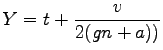
Institute of transportation engineers (ITE) has recommended a methodology for
computing the appropriate length of change interval which is as follows:
 |
(1) |
where  is the reaction time (about 1.0 sec), is the reaction time (about 1.0 sec),  is the velocity of the
approaching vehicles, is the velocity of the
approaching vehicles,  is the acceleration due to gravity (9.8 m/sec2), is the acceleration due to gravity (9.8 m/sec2),  is the grade of the approach in decimals and
  is the deceleration of
Change interval can also be approximately computed as y = SSD/v, where SSD is
the stopping sight distance and v is the speed of the vehicle.
The clearance interval is provided after yellow interval and as mentioned
earlier, it is used to clear off the vehicles in the intersection.
Clearance interval is optional in a signal design. It depends on the geometry
of the intersection.
If the intersection is small, then there is no need of clearance interval
whereas for very large intersections, it may be provided.
The clearance interval or all-red will facilitate a vehicle just crossed the
stop line at the turn of red to clear the intersection without being collided
by a vehicle from the next phase.
ITE recommends the following policy for the design of all read time, given as is the deceleration of
Change interval can also be approximately computed as y = SSD/v, where SSD is
the stopping sight distance and v is the speed of the vehicle.
The clearance interval is provided after yellow interval and as mentioned
earlier, it is used to clear off the vehicles in the intersection.
Clearance interval is optional in a signal design. It depends on the geometry
of the intersection.
If the intersection is small, then there is no need of clearance interval
whereas for very large intersections, it may be provided.
The clearance interval or all-red will facilitate a vehicle just crossed the
stop line at the turn of red to clear the intersection without being collided
by a vehicle from the next phase.
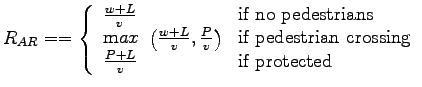
ITE recommends the following policy for the design of all read time, given as
 |
|
|
(2) |
where  is the width of the intersection from stop line to the farthest
conflicting traffic, is the width of the intersection from stop line to the farthest
conflicting traffic,  is the length of the vehicle (about 6 m), is the
speed of the vehicle, and is the length of the vehicle (about 6 m), is the
speed of the vehicle, and  is the width of the intersection from STOP line
to the farthest conflicting pedestrian cross-walk. is the width of the intersection from STOP line
to the farthest conflicting pedestrian cross-walk.
|
|
| | |
|
|
|


