| |
| | |
|
These signs are also called mandatory signs because it is mandatory that the
drivers must obey these signs.
If the driver fails to obey them, the control agency has the right to take
legal action against the driver.
These signs are primarily meant for the safety of other road users.
These signs have generally black legend on a white background.
They are circular in shape with red borders.
The regulatory signs can be further classified into :
- Right of way series: These include two unique signs that assign
the right of way to the selected approaches of an intersection.
They are the STOP sign and GIVE WAY sign
For example, when one minor road and major road meets at an intersection,
preference should be given to the vehicles passing through the major road.
Hence the give way sign board will be placed on the minor road to inform the
driver on the minor road that he should give way for the vehicles on the major
road.
In case two major roads are meeting, then the traffic engineer decides based on
the traffic on which approach the sign board has to be placed.
Stop sign is another example of regulatory signs that comes in right of way
series which requires the driver to stop the vehicle at the stop line.
- Speed series: Number of speed signs may be used to limit the speed
of the vehicle on the road.
They include typical speed limit signs, truck speed, minimum speed signs etc.
Speed limit signs are placed to limit the speed of the vehicle to a particular
speed for many reasons.
Separate truck speed limits are applied on high speed roadways where heavy
commercial vehicles must be limited to slower speeds than passenger cars for
safety reasons.
Minimum speed limits are applied on high speed roads like expressways, freeways
etc. where safety is again a predominant reason.
Very slow vehicles may present hazard to themselves and other vehicles also.
- Movement series: They contain a number of signs that affect
specific vehicle maneuvers.
These include turn signs, alignment signs, exclusion signs, one way signs etc.
Turn signs include turn prohibitions and lane use control signs.
Lane use signs make use of arrows to specify the movements which all vehicles
in the lane must take.
Turn signs are used to safely accommodate turns in unsignalized intersections.
- Parking series: They include parking signs which indicate not only
parking prohibitions or restrictions, but also indicate places where parking is
permitted, the type of vehicle to be parked, duration for parking etc.
- Pedestrian series: They include both legend and symbol signs. These
signs are meant for the safety of pedestrians and include signs indicating
pedestrian only roads, pedestrian crossing sites etc.
- Miscellaneous: Wide variety of signs that are included in this
category are: a "KEEP OF MEDIAN" sign, signs indicating road closures, signs
restricting vehicles carrying hazardous cargo or substances, signs indicating
vehicle weight limitations etc.
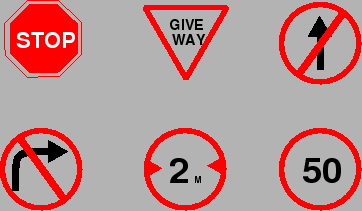
Some examples of the regulatory signs are shown in figure 1. They
include a stop sign, give way sign, signs for no entry, sign indicating
prohibition for right turn, vehicle width limit sign, speed limit sign etc.
Figure 1:
Examples of regulatory signs ( stop sign, give way sign, signs for no
entry, sign indicating prohibition for right turn, vehicle width limit sign,
speed limit sign)
 |
|
|
| | |
|
|
|


