| |
| | |
|
A test was conducted to determine the delay in an intersection.
Table 1 presents a sample computation on direct observation of
vehicle-in-queue counts at the intersection.
The traffic signal at the intersection operates with a cycle time of 115 sec.
The test was conducted on the 2 lane road over a 15-min period, which is almost
thirteen cycles .
Count interval was 15-s.
The total number of vehicle is 530 and the total number of stopped vehicle is
223.
Assume the free flow speed to be 65 km/h and the empirical adjustment factor
0.9
Figure 1:
Example of the intersection control delay worksheet
|
|
- Number of lane, N=2
- Free-flow Speed, FFS =65 km/h
- Survey count interval, Is =15 sec
- Total vehicle in queue,

- Total vehicles arriving,

- Stopped vehicles count,

- No of Cycle Surveyed, Nc=7.8
- Acc./Dec. correction factor, CF=4 (from Table 7.1)
- No. Of Vehicles stopped per lane each cycle

- Fraction of vehicles stopping,
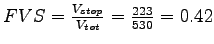
- Time-in-queue per vehicle ,

- Acc./Dec. correction delay,

- Control delay/vehicle,

|
|
| | |
|
|
|


![\includegraphics[width = 8cm]{qftable3}](img1.png)