| |
| | |
|
- Floating Car Method: Floating car data are positions of vehicles
traversing city streets throughout the day.
In this method the driver tries to float in the traffic stream passing as many
vehicles as pass the test car.
If the test vehicle overtakes as many vehicles as the test vehicle is passed
by, the test vehicles should, with sufficient number of runs, approach the
median speed of the traffic movement on the route.
In such a test vehicle, one passenger acts as observer while another records
duration of delays and the actual elapsed time of passing control points along
the route from start to finish of the run.
- Average Speed Method: In this method the driver is instructed to
travel at a speed that is judge to the representative of the speed of all
traffic at the time.
- Moving-vehicle method: In this method, the observer moves in the
traffic stream and makes a round trip on a test section.
The observer starts at section, drives the car in a particular direction say
eastward to another section, turns the vehicle around drives in the opposite
direction say westward toward the previous section again.
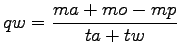
Let, the time in minutes it takes to travel east (from X-X to Y-Y) is ta, the
time in minutes it takes to travel west (from Y-Y to X-X) is tw, the number of
vehicles traveling east in the opposite lane while the test car is traveling
west be ma, the number of vehicles that overtake the test car while it is
traveling west be mo, and the number of vehicles that the test car passes while
it is traveling west from be mp.
Figure 1:
Illustration of moving observer method
|
|
The volume (qw) in the westbound direction can then be obtained from the
expression and
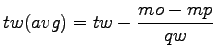
the average travel time in the westbound direction is obtained from
- Maximum-car method: In this procedure, the driver is asked to
drive as fast as is safely practical in the traffic stream without ever
exceeding the design speed of the facility.
- Elevated Observer method: In urban areas, it is sometime
possible to station observers in high buildings or other elevated points from
which a considerable length of route may be observed.
These investigator select vehicle at random and record; time, location and
causes-of-delay.
The drawback is that it is sometime difficult to secure suitable points for
observation throughout the length of the route to be studied.
- License Plate Method: when the amount of turning off and on the
route is not great and only over all speed value are to be secured, the
license-plate method of speed study may be satisfactorily employed.
Investigator stationed at control point along the route enters, on a time
control basis, the license-plate numbers of passing vehicles.
These are compared from point to point along the route, and the difference in
time values, through use of synchronized watches, is computed.
This method requires careful and time-consuming office work and does not show
locations, causes, frequency, or duration of delay.
Four basic methods of collecting and processing license plates normally
considered are:
- Manual: collecting license plates via pen and paper or audio
tape recorders and manually entering license plates and arrival times into a
computer.
- Portable Computer: collecting license plates in the field using
portable computers that automatically provide an arrival time stamp.
- Video with Manual Transcription: collecting license plates in
the field using video cameras or camcorders and manually transcribing license
plates using human observers.
- Video with Character Recognition: collecting license plates in
the field using video, and then automatically transcribing license plates and
arrival times into a computer using computerized license plate character
recognition.
- Photographic Method: This method is primarily a research tool,
it is useful in studies of interrelationship of several factors such as
spacing, speeds, lane usage, acceleration rates, merging and crossing
maneuvers, and delays at intersections.
This method is applicable to a short test section only.
- Interview Method: this method may be useful where a large amount
of material is needed in a minimum of time and at little expense for field
observation.
Usually the employees of a farm or establishment are asked to record their
travel time to and from work on a particular day.
- Highway Capacity Manual 2000 or (Cycle- based method): This
method is applicable to all under saturated signalized intersections.
For over-saturated conditions, queue buildup normally makes the method
impractical.
The method described here is applicable to situations in which the average
maximum queue per cycle is no more than about 20 to 25 veh/ln.
When queues are long or the demand to capacity ratio is near 1.0, care must be
taken to continue the vehicle-in-queue count past the end of the arrival count
period, vehicles that arrived during the survey period until all of them have
exited the intersection.as detailed below.
This requirement is for consistency with the analytic delay equation used in
the chapter text.method does not directly measure delay during deceleration and during a portion
of acceleration, which are very difficult to measure without sophisticated
tracking equipment.
However, this method has been shown to yield a reasonable estimate of control
delay.
The method includes an adjustment for errors that may occurred when this type
of sampling technique is used, as well as an acceleration-deceleration delay
correction factor Table 1.
The acceleration-deceleration factor is a function of the typical number of
vehicles in queue during each cycle and the normal free-flow speed when
vehicles are unimpeded by the signal.
Before beginning the detailed survey, the observers need to make an estimate of
the average free-flow speed during the study period.
Free-flow speed is the speed at which vehicles would pass unimpeded through the
intersection if the signal were green for an extended period.be obtained by driving through the intersection a few times when the signal is
green and there is no queue and recording the speed at a location least
affected by signal control.
Typically, the recording location should be upstream about mid-block.
Table 2 is a worksheet that can be used for
recording observations and computation of average time-in-queue delay
Table 1:
Acceleration-Deceleration Delay Correction Factor, CF (seconds)
| Free-Flow Speed |
 7 Vehicles 7 Vehicles |
8-19 Vehicles |
20-30 Vehicles |
 |
5 |
2 |
1 |
| 60-71 km/h |
7 |
4 |
2 |
 71 km/h 71 km/h |
9 |
7 |
5 |
|
Steps for data reduction
- Sum each column of vehicle-in-queue counts, then sum the column totals
for the entire survey period.
- A vehicle recorded as part of a vehicle-in-queue count is in queue, on
average, for the time interval between counts.
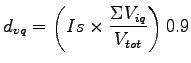
The average time-in-queue per vehicle arriving during the survey period is
estimated.
where, Is = interval between vehicle-in-queue counts (s),
 = sum
of vehicle-in-queue counts (veh), = sum
of vehicle-in-queue counts (veh),  = total number of vehicles arriving
during the survey period (veh), and 0.9 = empirical adjustment factor.
The 0.9 adjustment factor accounts for the errors that may occur when this type
of sampling technique is used to derive actual delay values, normally resulting
in an overestimate of delay. = total number of vehicles arriving
during the survey period (veh), and 0.9 = empirical adjustment factor.
The 0.9 adjustment factor accounts for the errors that may occur when this type
of sampling technique is used to derive actual delay values, normally resulting
in an overestimate of delay.
- Compute the fraction of vehicles stopping and the average number of
vehicles stopping per lane in each signal cycle, as indicated on the worksheet.
- Using Table 1, look up a correction factor
appropriate to the lane group free-flow speed and the average number of
vehicles stopping per lane in each cycle.
This factor adds an adjustment for deceleration and acceleration delay, which
cannot be measured directly with manual techniques.
- Multiply the correction factor by the fraction of vehicles stopping, and
then add this product to the time-in-queue value of Step 2 to obtain the final
estimate of control delay per vehicle.
Figure 2:
Intersection delay worksheet
|
|
|
|
| | |
|
|
|


![\includegraphics[height = 5cm]{qfmovingobservermethod}](img1.png)
![\includegraphics[height = 5cm]{qfControlDelayWorkSheet}](img10.png)