14.4 Biosynthesis of DNA: Replication
Each strand of DNA acts as a template for the formation of complementary new strand (Figure 1). The new (daughter) DNA molecules have the same genetic information as that of the parent DNA. The synthesis of the identical copies of DNA is known as replication(Figure 1).
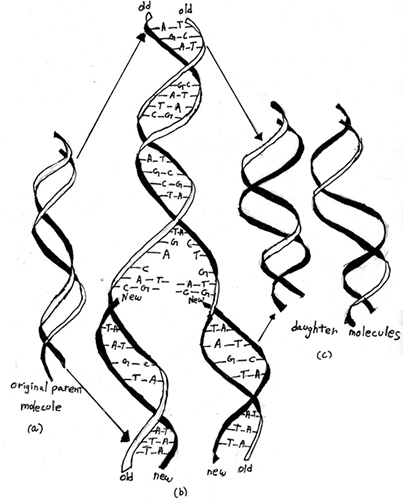
Figure 1
- The synthesis take place in a region where the strands have started to separate, because a nucleic acid can be synthesized only in the 5’ to 3’ direction.
- The synthesis is catalyzed by enzyme is known as DNA polymerase, and the fragments are joined together by an enzyme is called DNA ligase.
- In each of daughter DNA molecules, one strand comes from the parent DNA and another strand is synthesized. This process is called semiconservative replication.
14.5 Biosynthesis of RNA: Transcription
- The synthesis of RNA from DNA blueprint is known as transcription. It starts by DNA at a particular region to afford two single strands: (i) sense strand and (ii) template strand (Figure 2).
- The template strand read in 3’ to 5’ direction, and the RNA is synthesized in 5’ to 3’ direction.
- The base in the template strand specifies the base sequence to be incorporated in RNA.
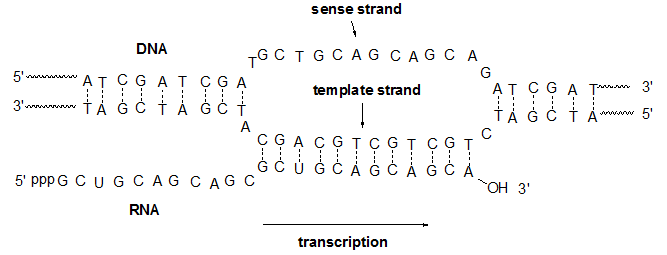
Figure 2. Biosynthesis of RNA
14.6 RNA
RNA is a single stranded polymer and does not form double helix. There are three types of RNA:
- Messenger RNA (mRNA), whose base sequence specifies the amino acid sequence in protein.
- ribosomal RNA (rRNA), that comprises the particles on which the biosynthesis of protein occurs.
- transfer RNA (tRNA), which carries the amino acid that will be incorporated into the protein.
- tRNAs are shorter than mRNA and rRNA, and folded into a characteristic cloverleaf like structure (Figure 3). They have a CCA sequence at the 3’end, and the three bases at the bottom are called anticoden.
- Each tRNA carries an amino acid as an ester to its terminal 3’OH. The amino acid will be inserted into a protein during the protein synthesis.