10.1 Introduction
Lipids are organic compounds that are found in living organisms. They have variety of structures and functions, and soluble in organic solvents due to their hydrocarbon component. Scheme 1 illustrates some examples:
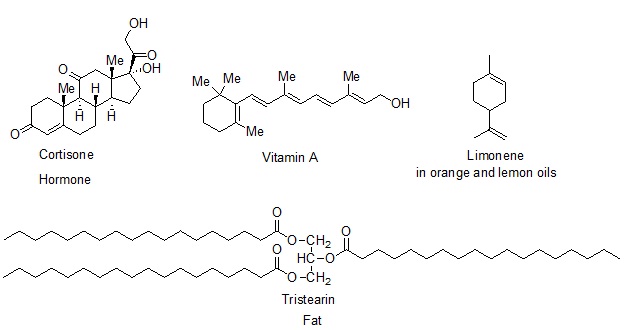
Scheme 1
10.2 Fatty Acids
Fatty acids are unbranched carboxylic acids having long hydrocarbon chains (Scheme 2). Most of the naturally available fatty acids bears an even number of carbon atoms due to their synthesis from acetate. Both saturated and unsaturated fatty acids are available. In unsaturated fatty acids, the double bonds have cis-configuration and are separated by one CH2 group. Thus, unsaturated fatty acids have less intermolecular interactions compared to saturated fatty acids. As a result, the unsaturated fatty acids have lower melting points in comparison to saturated fatty acids. The melting point decreases as the number of double bonds increases.