Iron-sulfur proteins:
The iron-sulfur proteins occurs extensively in all living organisms and take part in a wide range of electron-transfer processes, either as redox centers ( e . g . ferredoxins, rubredoxins) or as catalysts ( e . g . hydrogenase, nitrogenase, etc).
[1Fe-0S] proteins:
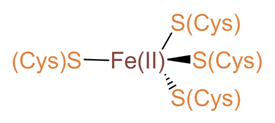
Iron-sulfur proteins with no bridging sulfur (0S) or sulfide atom is known as rubredoxins. It is mainly found in bacteria and acts as one electron donor-acceptor. The arrangement around the iron center is tetrahedral and the Fe(II) center is surrounded by four sulfur atoms from four cystine (Cys) moieties .
[2Fe-2S], [3Fe-4S], and [4Fe-4S]:
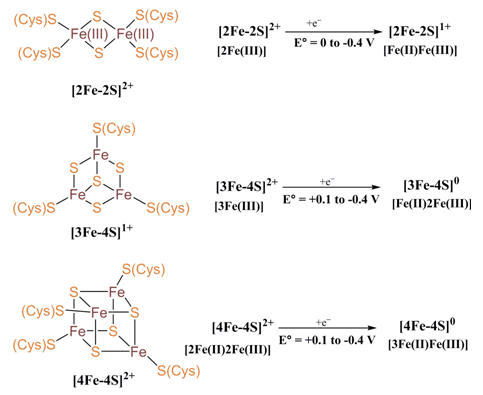
Figure 7.12. Schematic representation for rubredoxins and ferredoxins.
Ferredoxins are most important family of iron-sulfur proteins. Three major categories of ferredoxins are, [2Fe-2S], [3Fe-4S], and [4Fe-4S]. The [4Fe-4S] is most important.
[2Fe-2S]: Isolated from mammals, plants, and bacteria. Both the iron centers are in tetrahedral coordination environment and linked by two inorganic sulfide bridges. Both Fe(III) centers are antiferromagnetically coupled to each other. Hence, a diamagnetic ground state results. After accepting a electron one center becomes Fe(II) and the other is Fe(III). After antiferromagnetic coupling between the S = ½ ground state appeared.
[3Fe-4S]: Found in Azobacter vinlandii , and Desulfovibrio gigas and also in pig heart. All the iron centers are in tetrahedral coordination environment and linked with each other by two inorganic sulfide bridges.
[3Fe-4S]: It is found is several iron containing metalloenzymes like nitrogenase, hydrogenase, etc. The structure is a distorted cubic core. The alternative corners of the cube are occupied by iron and inorganic sulfide. Irons are connected to each other via two sulfide bridges. All the iron centers are tetrahedral.
Nitrogenase:
Nitrogen-fixing bacteria found in soil and root nodules of certain plants contain an enzyme called nitrogenase that reduces molecular nitrogen to ammonia.
Reaction:

The enzyme is composed of three compartments;
- Two ATP bound one [Fe4S4]+ cluster
- One P N cluster. It is a edge sharing fused structure of two [Fe4S4]+ clusters, and
- Fe-Mo cluster.
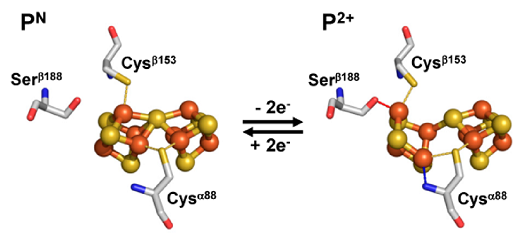
Figure 7.13. PN and P2+ clusters present in nitrogenase enzyme (taken from J. Am. Chem. Soc. 2012, 134, 13749 − 13754 )