4.4.1. Site Specific Binding of Enediynes to DNA
It is known that enediynes cleave double strand DNA, causing both single and double strand cuts. The enediynes bind to the minor groove of double helical DNA at specific sites. The predominantly sequences of sites are:
- for Calichiamicin (CAL) at 5'-TCCT-3', 5'-TTGT-3' and 5'-ATCT-3';
- for Neocarzinostatin chromophore (NCS) at 5'-GGAGCGC-3'
- for Dynamicin (DYN) at 5'-CTACTACTGG-3', 5'-AG-3', 5'-AT-3', and 5'-GC-3'
- for kedarcidin at 5'-TCCT-3'
- for N1999A2 at 5'-GGT-3'
- for Esperamicin (ESP) at 5'-CTC-3', 5'-TTC-3', and 5'-TTT-3'
- for Lidamycin (LDM) at 5'-CTTTT-3', 5'-ATAAT-3', 5'-CTTTA- 3', 5'-CTCTT-3', and especially 5'-GTTAT-3'.
The studies suggest 4'-H atom abstraction along with 5'-H abstraction from the targeted DNA deoxyribose sugars ( Scheme 2 ).
- In the case of CAL, the diradical abstracts hydrogen atoms from duplex DNA at the C-5' position of the cytidine and the C-4' position of the three nucleotide base pairs removed on the 3'-side of the complementary strand, leading to cleavage of both strands of DNA.
- NCS is converted into a diradical that attacks the C-5' position of the deoxyribose of mainly thymidylate residues in DNA.
- In the ESP-mediated DNA degradation, thymidylate and deoxycytidylate residues at the C-4' and/or C-5' position are preferred cleavage sites.
- CAL, ESP and DYN have potent DNA cleavage activity in the presence of thiol compounds and the characteristic of DNA cleavage is induction by NADPH.
- NCS requires sulfhydryl activation for the activity which results in lower selectivity and cytotoxic activity.
- The LDM diradical also abstracts hydrogen atoms at the C4' and C5' position of the adenine residue on the opposite strand, inducing double-strand break.
- LDM has higher DNA cleaving ability compared with other enediyne compounds such as NCS, ESP, CAL and kedarcidin. Even in the absence of thiols or reductants, LDM still induces high DNA breakage. LDM induces novel DNA interstrand cross-links and drug monoadducts under anaerobic conditions, which is similar to that in the center regions of large tumors.
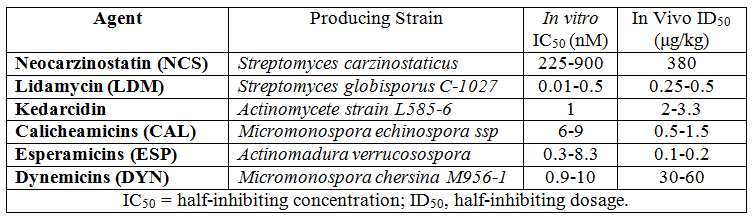
Table 2: In vitro test results for anticancer activities of enediyne anticancer antibiotics
4.5. Enediyne-Induced Cell Cycle Arrest
The DNA damage caused by enediyne leads to the initiation of cellular recovery mechanisms that involve activation of DNA damage response pathways, cell cycle arrest and apoptosis.
Calichiamicin (CAL) induced double-strand DNA cleavages are repaired slowly but completely. This process results in high levels of H2AX phosphorylation and efficient cell cycle arrest. Investigation of the mode of action of CAL in living cells, revealed that upon longer CAL exposure, genes involved in chromatin arrangement, DNA repair and/or oxidative damage, DNA synthesis and cell cycle checkpoint control as well as other nuclear proteins expression.
LDM-induced cell cycle arrests are associated with the status of the tumor suppressor gene p53 . It is known that LDM at low concentrations induce G1 arrest in p53 wild-type MCF-7 cells. However at high concentration LDM caused both G1 and G2/M arrests with an increase of p53 and p21, and a decrease of phosphorylated retinoblastoma protein, Cdk1 and cyclin B1 protein levels. LDM also induced G2 arrest in p53-mutant human colon carcinoma HT-29 cells. LDM induced G2 arrest Lead to cytoplasmic localization of cyclin B1.
Treatment with Neocarzinostatin (NCS) was found to inhibit cellular proliferation through G2 cell cycle arrest. NCS also causes apoptosis induction in cervical cancer HeLa, INBL, CaSki and C33A cell lines. The mechanism of NCS-induced G2 block is closely related to X-ray-induced G2 block. Caffeine act as a stimulator of the recovery of HeLa-S3 cells from the arrested G2 cell cycle by NCS. NCS-induced inhibition of DNA synthesis and mitosis was found to be markedly reduced when caffeine was coadministered with NCS.
4.6. Enediyne-Induced Cell Death
After DNA damage, cells can be arrested at some phase of the cell cycle to facilitate DNA repair or induced apoptosis ( Apoptosis is the process of programmed cell death (PCD) that may occur in multicellular organisms). DNA damage is a critical event preceding cellular apoptosis and appears to signal cell death through the mitochondria. The ability of the enediynes to induce apoptosis is mostly related to their ability to make double-strand cuts in DNA. The simple enediyne models are less effective that natural enediynes because of the lack of DNA binding appendages like oligosaccharides/peripheral decoration with aromatic units in natural enediynes.
It was reported that CAL-induced apoptosis is independent of the death-receptor/ FADD-mediated signals. CAL triggered apoptosis in a p53-independent manner. The cell death occurs via activation of mitochondria, release of cytochrome c and activation of caspase-9 and -3.
Human promyelocytic leukemia HL-60 cells to undergo apoptosis with morphological changes, condensation of nuclear chromatin, and a typical ladder pattern of DNA fragments upon exposure with LDM. LDM-induced apoptosis is more effective in human colorectal cancer cells with wild type p53 than those with mutant or deleted p53. LDM in low dose causes blocking of apoptosis through the inhibition of the mitochondrial pathway. However, in high dose LDM causes rapid apoptosis through direct DNA damaging mechanism and the process is independent of activation of p53 and caspase. In this case the apoptosis is not be blocked by a caspase inhibitor.
Neocarzinostatin (NCS) induces apoptosis in MCF-7 cells. This is characterized by decreased Bcl-2 and increased Bax levels that induce the release of cytochrome c from the mitochondria, and then activates caspase 9. Activation of caspase 9 induces sequential activation of caspase 7 and caspase 6 leading to apoptosis.