2.4 Biosynthesis of a Few Members of Natural Enediynes
2.4.1. Introduction
Microorganisms mostly from soil and marine natural source, (such as bacteria, fungi) produce a large variety of substances (secondary metabolites) with a vast diversity of fascinating molecular architecture and potent biological activities that are not available in any other systems. Enediyne class of natural product is of such fascinating examples produced by microorganisms and isolated. Biosynthesis of secondary metabolites includes (a) finding the reactions available in nature, (b) study of the enzymatic mechanisms of these reactions, (c) investigating how these reactions are linked to produce complex architechture, and (d) the regulatory mechanisms of the pathways they are formed, (e) to manipulate nature's biosynthetic machinery for the discovery and development of new drugs of microbes origin.
The biosynthesis of the enediynes is intriguing because of the uniqueness of the chemical structures of these classes of molecules. The origin of the enediyne core was initially studied using isotope-labeling experiments (by monitoring the production of neocarzinostatin, dynemicin, and esperamicin) which established the acetate as a precursor unit. However, the answer of whether the enediyne core was constructed by the degradation of fatty acids or by de novo biosynthesis with a dedicated fatty acid or polyketide synthase (PKS) was unclear.
Cloning and characterization of the gene clusters for 5 enediynes, [C-1027, neocarzinostatin (NCS), calicheamicin, dynemicin, and maduropeptin], led the foundation of investigating enediyne biosynthesis. Since then molecular and biochemical studies are being undertaken for deciphering enediyne biosynthesis.
2.4.2 Enediyne Biosynthesis in the Pre-Genomic Era
In early 1988, Schreiber and Kiessling devised concised synthetic routes for the enediyne cores of calicheamicins and neocarzinostatin. They envisaged that the branched molecule A might be the common biosynthetic precursor for both the 9- and 10-membered enediynes. Considering this, they demonstrated that a series of steps including (a) electrocyclic ring closure, (b) proton transfer and (c) oxidation could transform A into a 9-membered enediyne (pathway I, Figure 6). On the other hand an intra-molecular Diels–Alder reaction followed by the addition of one carbon unit at the acetylene terminus could convert structure A into a 10-membered enediyne (pathway II, Figure 6).
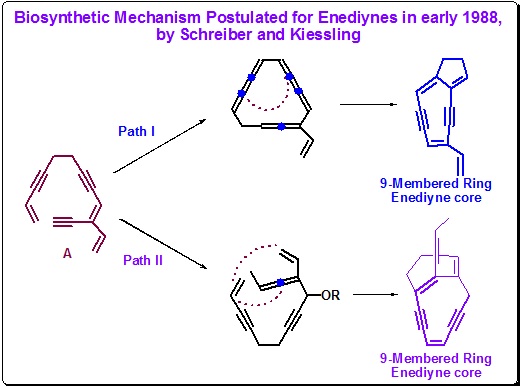 |
Figure 6. An early biosynthetic mechanism postulated for enediynes. |
Later on, in 1989, Hensens et al. produced 13C-enriched neocarzinostatin by feeding 13C-labeled acetate to Streptomyces carzinostaticus. This study confirmed the structures of neocarzinostatin chromophores proposed by Edo and Myers. The first clue about the biosynthetic origins of the molecular building blocks also came from their studies. The experiment with singly labeled acetate suggested that the bicyclo[7.3.0]dodecadienediyne moiety could be derived from a linear precursor that consists of seven acetate units (Figure 7). That the acetates are assembled in a head-to-tail fashion was evident from the study of culturing with doubly- and mixed-labeled acetate. Most importantly, they envisaged that the two carbons of the -yne group originate from the same acetate unit, which brings the difference between the 9- and 10-membered enediynes. They also proposed that the linear precursor derived from oleate or crepenynate is truncated on both ends prior to cyclization. Subsequent oxidation, cyclization and oxygenation would furnish the fully functionalized 14-carbon enediyne core.
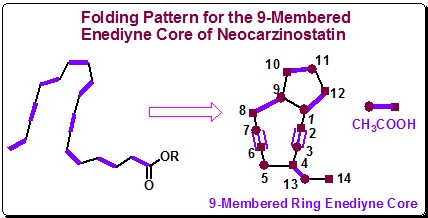 |
Figure 7. Folding pattern for the 9-membered enediyne of neocarzinostatin. |
Another isotopic labeling study by Tokiwa et al. revealed a very different 13C-incoporation pattern for the bicyclo[7.3.1]-tridecadiynene core of dynemicin A isolated from Micromonospora chersina M956-1. They proposed that the bicyclic enediyne core and the anthraquinone moiety of dynemicin A are derived from two heptaketide chains that consist of two sets of seven acetate units. There are two possible pathways for the linear heptaketide to fold into the final bicyclic structure (Figure 8). Identification of the incorporated acetate units from the [1,2-13C2] acetate feeding experiment suggested that the cyclization followed pathway (a) rather than path (b). From their results, it was also clear that the two carbons of one -yne group in dynemicin are derived from different acetate units which is contrary to the early finding that the two carbons of the -yne group in neocarzinostatin originate from the same acetate unit. From the earlier studies it was postulated that uncialamycin, the other member of the dynemicin-type enediyne subfamily containing a different enediyne core, is derived from a dynemicin-like precursor.
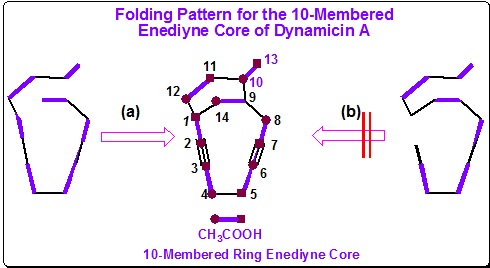 |
Figure 8. Folding patterns for the 10-membered enediyne of dynemicin A. |
A similar isotopic labeling experiment was performed for investigating the biosynthetic route to the esperamicin producing Actinomadura verrucosospora. This experiment suggested that the enediyne of esperamicin A1 is also assembled from seven acetate units in a head-to-tail fashion. In this case, there four possible pathways were proposed for the linear heptaketide to fold into the bicyclic structure (Figure 9). Identification of the incorporated acetate units, particularly the starting acetate unit C11–C12, ruled out the pathways a, b and d. It was observed that the production of esperamicin A1 by A. verrucosospora was significantly reduced by administrating cerulenin, an inhibitor that targets the β-ketosynthase (KS) domain of both fatty acid synthase (FAS) and polyketide synthase (PKS), whereas supplementation of the culture with the fatty acid oleate did not restore the biosynthesis. These observations suggested that the enediyne core is probably derived from a polyketide precursor, rather than a fatty acid one. Further, the three isotopic labeling experiments provided clues that linear polyketide precursors consist of head-to-tail coupled acetate units. The differences in isotope incorporation pattern among neocarzinostatin, calicheamicin and dynemicin indicated the different origins of the -yne carbons and hence suggesting the different biosynthetic pathways for these enediynes.
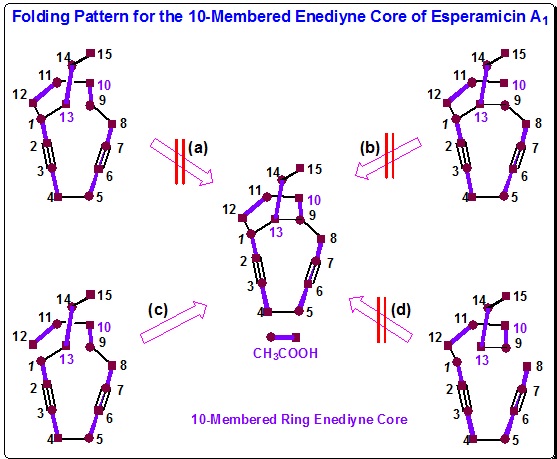 |
Figure 9. Proposed biosynthetic pathways for the linear heptaketide to fold into the bicyclic structure of 10-membered ring enediynes. |