1.5 Molecular Structure of Enediynes
The common structural motif among enediyne antibiotics is an enediyne moiety (Z-hexa-1,5-diyn-3-ene), the conjugated system, found embedded within a 9- or 10-membered cyclic framework. The enediyne antibiotics have been divided into two subfamilies, including 9-membered cyclic enediynes such as NCS, kedarcidin, LDM, maduropeptin and N1999A2 and 10-membered cyclic enediynes such as CAL, ESP, DYN, and shishijimicins A-C (Figure 8).
9-membered cyclic enediynes contain the chromophore containing the enediyne core and an apoprotein unit with noncovalent binding. The enediyne core of the chromophore is located in the center of the pocket and other substituents are arranged around the core. The enediyne core of the chromophore is the anticancer part, but the free chromophore is labile. The apoprotein is inactive in cleavage of DNA; however it plays an important role in drug action by stabilizing the labile chromophore. The apoprotein is believed to be resistant to proteases, protect the chromophore from deactivation and to deliver the enediyne to intracellular target DNA. Only N1999A2 is a non-protein 9-membered cyclic enediyne antibiotic and is stable in nature.
The structures of 10-membered cyclic enediynes do not contain an apoprotein and are more stable than those of 9-membered cyclic enediynes.
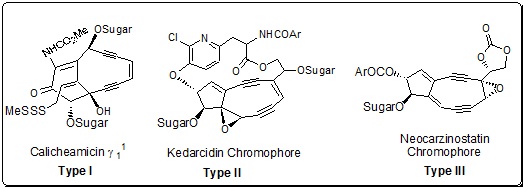 |
Figure 8. Presentation of three types of enediynes |
In calicheamicins and dynemicins, a 3-ene-1, 5-diyne system is embedded in a 10-membered ring. These compounds belong to Type I enediynes.
In Type II enediynes, the 3-ene-1, 5-diyne system is included in a 9-membered ring as in kedarcidin.
There is another class of enediyne (Type III), in which a 9-membered cyclic dienediyne is present as in neocarzinostatin.
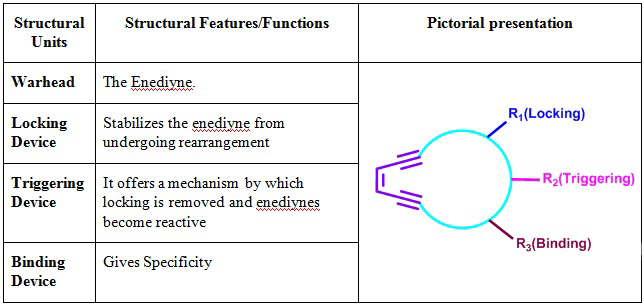
The enediynes represent an ingenuity of nature’s work. It has been compared to a smart bomb equipped with: a) a delivery system which is responsible for a strong and specific complexation with DNA. This system is represented by the oligosaccharide unit as in calicheamicin and esperamicin; b) a warhead (the enediyne moiety) that is able to attack simultaneously the two complementary DNA strands, causing the lethal double strand cut; c) a safety catch or a locking devicethat prevents the enediyne from undergoing the diradical formation, by imposing a structural restraint to its reaction. In this way the warhead does not explode until a particular chemical event takes place. In calichamicin this is represented by the enamine double bond; d) finally, a chemical trigger that mediates the removal of the safety catch and therefore unleashes the high reactivity of the enediyne. In calicheamicins the trigger is the trisulfide group (Table 1, Figure 9).
Table 1. Structural features of enediynes.
 |
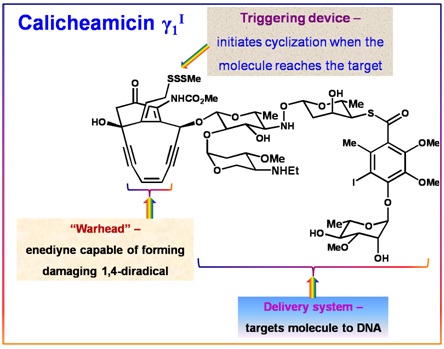 |
Figure 9. Structural features of Calicheamicin. |