Titanium, an abundant and non-toxic transition metal, has been often used for the modification of organolithium and organomagnesium compounds. The preparation of individual titanium reagents is usually carried out by ligand exchange on, e.g. TiCl4 , Ti(OiPr)4 or cyclopentadienyl-titanium trichloride (Scheme 1). Chloride ligands can be replaced by protonated (LH), silylated (LSiMe3), stannylated (LSnR3) or metalated (LM, M = Li, MgX) ligands. Volatiles such as HCl and Me3SiCl can be removed by evaporation. Alkoxide ligands can be exchanged through adduct formation with alcohols. Many of the titanium compounds are moisture sensitive. The resulting hydroxo compounds are acidic and form μ-oxo dimers or trimers. With more water, complete hydrolysis occurs to give titanium dioxide. This section covers the recent developments on the use organotitanium compounds in organic synthesis.
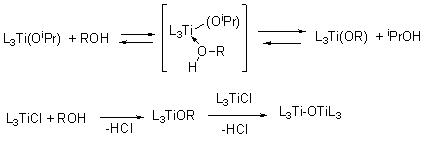 |
Scheme 1 |
3.8.5.1 Nucleophilic Addition to Aldehydes
Titanium(IV)-mediated addition of nucleophiles to aldehydes exhibits excellent stereocontrol. The attacking nucleophile is either ligand of the activating titanium complex or an additional reagent. The stereoselectivity results from the bias of the titanium center (Scheme 2). For examples, asymmetric allylation of aldehydes and ‘ene' reactions mediated by chiral titanium complexes provide the corresponding homoallylic alcohols with excellent enantioselectivity (Scheme 3-4).
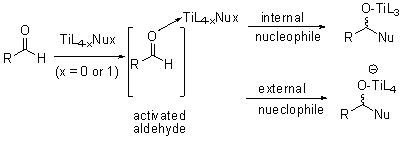 |
Scheme 2 |
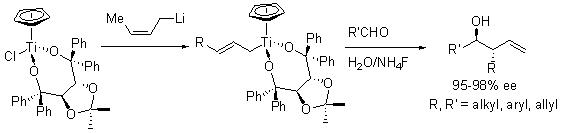 |
Scheme 3 |
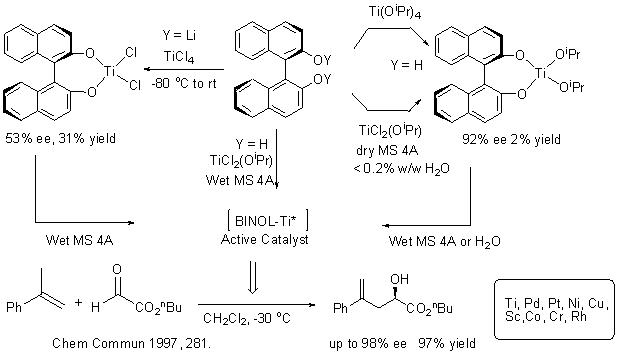 |
Scheme 4 |