1.5.1 Introduction
A number of peracids having the general formula, RCO3H have been used for the oxidation of organic compounds. Some of the common peracids are: peracetic acid (CH3CO3H), perbenzoic acid (PhCO3H), trifluoroacetic acid (CF3CO3H) and m-chloroperbenzoic acid (m-ClC6H4CO3H). Peracids are usually prepared in situ by the oxidation of carboxylic acid with hydrogen peroxide.
1.5.2 Epoxidation of Alkenes
Epoxides are useful building blocks in organic synthesis as they react with a variety of nucleophiles resulting in opening epoxide ring. An effective route for the synthesis of epoxides is the direct conversion of alkenes to epoxides using peracids as oxidizing agent. m-CPBA is often used for this purpose because it is available commercially as a colorless crystalline solid. The reaction is carried out at ambient conditions in chlorinated solvent such as dichloromethane (Scheme 1). m-Chlorobenzoic acid is produced as a by-product, which can be removed by washing the reaction mixture with saturated NaHCO3 solution.
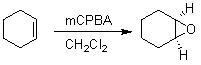 |
Scheme 1 |
The reaction is stereospecific leading to the syn addition of the oxygen atom to alkene. Thus, cis alkene gives cis-epoxide and trans alkene gives trans-epoxide (Scheme 2). The electron rich alkene shows greater reactivity compared to electron deficient alkenes toward m-CPBA. Thus, terminal alkenes exhibit slower reactivity compared alkyl substituted alkenes (Scheme 3). Peracid having electron withdrawing substituent exhibits greater reactivity compared to that containing electron donating group. For an example, m-CPBA is more reactive compared to PhCO3H.
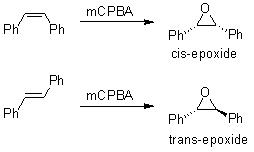 |
Scheme 2 |
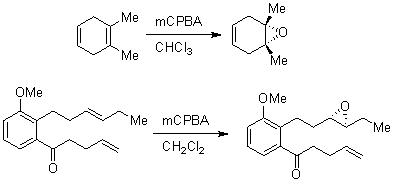 |
Scheme 3 |