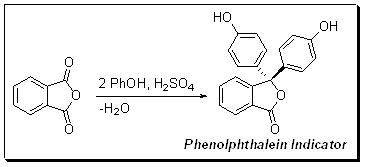
5.1 Principles
The reaction occurs in two stages: the electrophile adds to one carbon atom of the aromatic ring, yielding a carbocation in which the positive charge is delocalized, and a proton is then eliminated from the adduct.
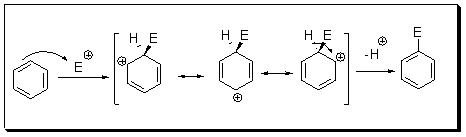
5.2 Formation of Carbon-Carbon Bonds
5.2.1 Friedel-Crafts Acylation
Acylation of aromatic rings is generally peroformed using acid chloride or acid anhydride as an acylating agent in the presence of Lewis acid.
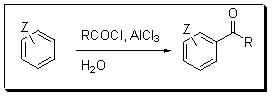
Mechanism
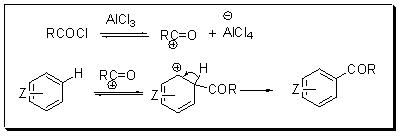
In some circumstances, carboxylic acid is used as an acylating agent in the presence of a proton acid.