Another way to increase the E-factor is to use catalytic amount of chromium reagents for oxidation. Thus, Cr(III)-salen complexes have been used for oxidation of alcohols. The combination of Cr(III)-salen along with terminal oxidant PhIO is selective for allylic, benzylic and cyclopropyl alcohols (Scheme 6).
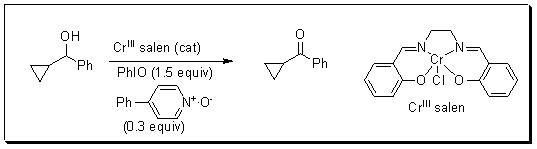
Scheme 6
3.6.2 Reactions of Chromium-Arene Complex
3.6.2.1 Nucleophilic Addition
Arylchromium complexes prepared by heating Cr(CO)6 with arene have found use as a source of preparation of arene derivatives by attack of a nucleophile (Scheme 6). The rationale for this lies in the fact that arylchromiumtricarbonyl complexes follow 18 electron complexes and as such
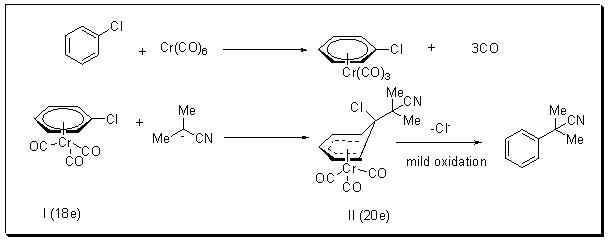
Scheme 7
they have a tendency to preserve the 18e structure. For example, (η6-chlorophenyl)tri-carbonylchromium(0) has 18e which on addition of nucleophile generates intermediate II with 20e that loses 2 electrons by losing chloride to regain its 18e structure.