10.3 Silicon-Containing Compounds
Both silicon and carbon have similarity in having valency of four and formation of tetrahedral compounds. Regarding the differences, carbon forms many stable trigonal and linear compounds having p bonds, while silicon forms few. This is because of the strength of the silicon-oxygen σ bond (368 KJ mol -1 ) as well as the relative weakness of the silicon-silicon (230 KJ mol -1 ) bond.
10.3.1 Nucleophilic Substitution Reactions
Nucleophilic substitution at silicon differs in comparison to carbon compounds. For example, trimethylsilyl chloride does not react via SN1 pathway which is familiar with the analogous carbon compound t-butyl chloride. This is because the SN2 reaction at silicon is too good.
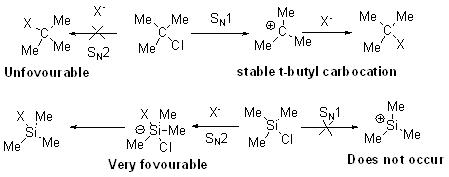
Scheme 1
Let us compare the SN2 reaction at silicon with the SN2 reaction at carbon. Alkyl halides are soft electrophiles but silyl halides are hard electrophiles. The best nucleophiles for saturated carbon are neutral or based on elements down the periodic table, whereas the best nucleophiles to silicon are charged or based on highly electronegative atoms. A familiar example is the reaction of enolates at carbon with alkyl halides but at oxygen with silyl chlorides (Scheme 2).
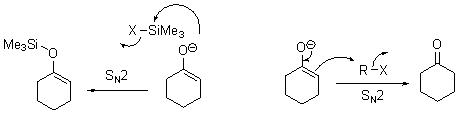
Scheme 2
Furthermore, the SN2 reaction at carbon is not much affected by partial positive charge ( δ +) on the carbon atom. However, the SN2 reaction at silicon is affected by the charge on silicon. For example, the most electrophilic silyl triflates react 109 times fast with oxygen nucleophiles than silyl chlorides do (Scheme 3).
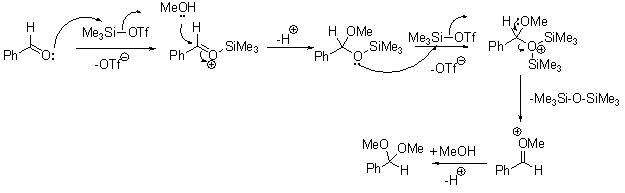
Scheme 3