|
Now we will take a “closer look” at the Nitrification Process
|

Nitrification is a biological process during which nitrifying bacteria convert toxic ammonia to less harmful nitrate. Nitrification aids in the decomposition of nitrogenous material and thus in the recycling of nitrogen atoms since the decontamination of organic nitrogen produces ammonia that is subsequently oxidized to nitrate by nitrification.
There two bacterial species involved. Nitrosomonas sp. Bacteria oxidize ammonia into nitrite, while Nitrobacter bacteria convert nitrite to nitrate, with both species utilizing the energy released by the reactions. Ammonia can be used by some plants. Most nitrogen taken up by plants is converted by chemoautotrophic bacteria from ammonia, which is highly toxic to many organisms, first into nitrite (NO2-), and then into nitrate (NO3-). This process is called nitrification, and these bacteria are known as nitrifying bacteria. |
|

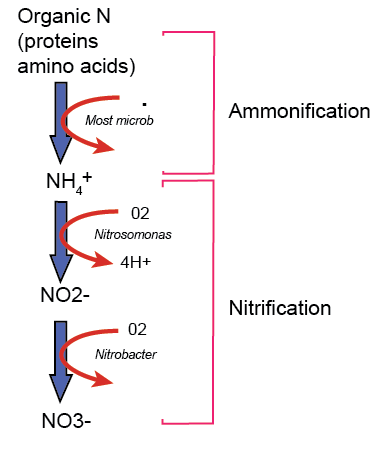
Nitrifiers such as Arthrobacter (heterotroph), Aspergilli’s (heterotroph), and Nitrosomonas (autotroph) are delicate organisms and extremely susceptible to a variety of inhibitors. They are extremely slow growing, unlike many bacteria that can double their numbers every hour or so. In order to thrive, nitrifying bacteria need a relatively clean environment with a steady supply of ammonia and oxygen.