| |
The validity of the basic findings of the Smoluchowski analysis of colloidal coagulation rates has been tested many times. The stability factor ‘W’, being experimentally accessible, has played a vital role in the development of the notion of colloidal stability. The log(W)-log(c) plot is of a bilinear nature and allows for determination of a kinetic c.c.c. (critical coagulation concentration), and a great amount of literature is available on the interpretation of W for a variety of colloids.
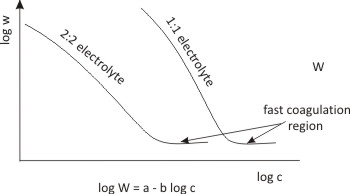
Fig.10.12: The above plot shows the bilinear nature of the log W plot, log W= a-b log c
The ccc is the critical salt concentration at which there is a change from coagulation, limited by the presence of a primary maximum to coagulation which has no barrier. At this point there is a distinct change in the coagulation rate. Measurement techniques for the coagulation rate can be broadly classified into two categories:
- directly – by counting the number of particles, measuring the number of particles as a function of time, best suited for large particles
- indirectly – by experimental techniques such as light scattering, best suited for small particles, for which direct counting becomes difficult.
|