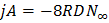
In this case only concentration gradient is driving the coagulation. At steady state number of particles crossing the surface would be constant so left hand side of eq.(10.17) is constant. Thus,

Applying this condition in equation (10.17) would give a second order differential equation for steady state diffusion. Assuming concentration of particle as  is and is and  at r=2R, N=0. With these boundary conditions we can integrate equation (10.17) as at r=2R, N=0. With these boundary conditions we can integrate equation (10.17) as
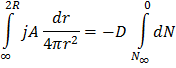
On integration and substitution of limits we get,
We have assumed that reference particle is stationary. In general all particles would be approaching towards each other. We can allow for the fact that all particles are in motion by using the sum of the diffusion constants of the two colliding particles. So if we want remove the restriction that the reference is stationary, then we have to replace diffusion coefficient ‘D’ by ‘2D’ when the particles are of same size or (D1+ D2, in general). This would take account of relative diffusion of all particles in each other. Thus number of particles crossing the spherical shell per unit time at steady state is

|