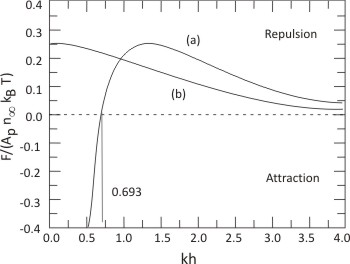
FIg 9.6: Electrostatic double layer force between two constent potential surfaces.
Case (a)  and Case (b) and Case (b) 
Reference: pg. 144 Electrokinetic and colloid transport phenomenon, Masliyah J. H. and Bhattarcharjee S. ; John Wiley & Sons Inc. , 2006
Surfaces of same sign but of dissimilar potentials can encounter attractive forces on close approach has a major impact in the area of coagulation. This behavior at close separation is because of change in sign of the surface charges on one of the surface due to the overlapping double layer. In case (a) with dissimilar surface potential the electrostatic force becomes attractive at some distance whereas in case (b) with similar potential the force remains repulsive all the time.
If the two plates have charge density σ1 and σ2, then by electric neutrality of the system we can write
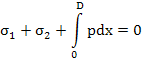
Substituting ρ from Poisson equation we have
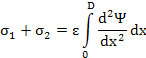
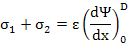

As we have calculated earlier ψ(x) can be calculated either by Gouy Chapman equation or under Debye-Huckel approximation.
Surface potential application in biology: It has wide range of applications at biological membranes and proteins. The ions in solution will be capable of concentrating or depleting at the surface depending on the potential sign and valence of the ion. The effect for membrane is comparatively larger than for proteins, as potentials are generally higher.
In biotechnology, the purification of proteins are done with salting-in and salting-out mechanism which can be evaluated with Debye Huckel approximation. Diseases such as gout (characterized by deposition of sodium urate crystals) and kidney stones (deposition of calcium oxalate crystals) are studied to determine the various affects leading to deposition of salts and inducing their dissolution in biological buffer. Protein folding mechanisms and diseases caused due to protein aggregation such as Alzheimer’s are being investigated using this approximation.
|