If there are N no. of streams going inside a process and M no. of streams coming out of a process, the mass balance equations for the process can be written as:
|
|
(II.2) |
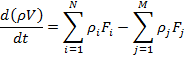
Where  and V represent the density and volume of the material inside the system and
  and
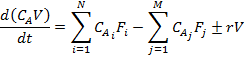
and  are the density and flow rate of the incoming/outgoing streams respectively. In case of a chemical reaction, let
  and
and  be the concentrations of component A of material inside the process and the streams respectively and r be the rate of the reaction. The component balance equations can be written as
|
|
(II.3) |
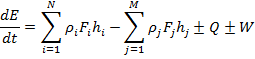
Let h and  be the enthalpies of material inside the process and incoming/outgoing streams respectively, Q be the heat supplied to the
system
(or heat removed from the
system
), W is the work done on (or by) the system. Then the energy (E) balance equation for such system is written as
be the enthalpies of material inside the process and incoming/outgoing streams respectively, Q be the heat supplied to the
system
(or heat removed from the
system
), W is the work done on (or by) the system. Then the energy (E) balance equation for such system is written as
|
|
(II.4) |
As the chemical process plants are usually static, momentum balance equations are usually not required for such cases.
In addition to the above state equations, a few algebraic equations are also useful for modeling of a chemical process. Examples of such equations are:
|
Transport rate equation: |
|
(II.5a) |
|
Kinetic rate equation: |
|
(II.5b) |
|
Phase equilibrium equation: |
|
(II.5c) |
|
Gas law: |
|
(II.5d) |



