5.1. Introduction to Monte Carlo
Monte Carlo (MC) simulation is a stochastic simulation method, which relies on the probability distribution of certain system parameters. There is some probability associated with that particular event and the selection of a particular probable event is decided by the random numbers. This is different from the Molecular Dynamics (MD) simulation method, which follows a deterministic approach (viz., using Newton's law of motion).
One of the simple probabilistically controlled examples is the tossing of a coin: the event has two outcomes: H (head) or T (tail). It can be assumed that the probability of occurring H or T is identical and equal to 0.5, i.e., P(H) = P(T) = 0.5
Now for a finite number of trials, the number of H and T is not equal. If the number of trials à 8, the value of P(H) = P(T) = 0.5, and the number of H and T becomes equal.
5.1.1. MC is a decision making tool
In a simple word, MC can be considered as a decision making tool. Let's take an example: Suppose there are two routes from your hostel, one goes to play ground and other goes to class room. Assuming that the probability of visiting playground, P(G) is 0.7 and going to the class, P(C) is 0.3. Now in a given day, where your location would be? Since, you cannot be present at both the places at the same time. Then the question comes: how do you make the decision? To make a decision, take a reference or standard device (Random Number) and compare suitably to make the final decision. Following is the schematic presentation of distribution of probabilities:
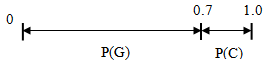
At any given day pick up a random number (uniformly distributed between 0 & 1) and see on which range it falls. If it is = 0.7, then go to play ground, else go the class. This is the way you can make your decision perfect.