1.15 Benchmarking with Ionic Liquids
Geometry optimization procedure has been illustrated here for 1-butyl-3-methyl imidazolium hexafluorophosphate ([Bmim][PF6]) which has the following structural formula as shown in Fig. 1.7.
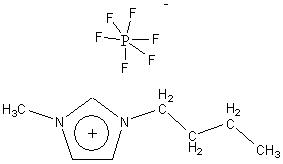 |
Figure 1.7 Molecular structure of [bmim]+[PF6]- |
The geometry optimization of this IL was carried out by optimizing the cation and anion pair through dummy atom. MOLDEN [Schaftenaar 2000] was used to generate the initial structure of the ionic liquid (Figure 1.7). The corresponding Z-matrix was written to a file. The Z-matrix file was edited to specify the complete input. The charge is 0 and the multiplicity is 1. The HF/6-31G* opt route was used.
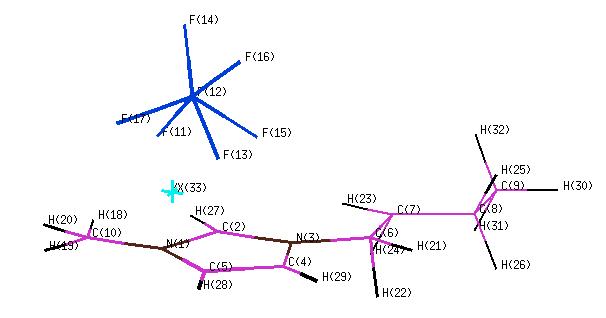 |
| Figure 1.8. Input (starting) geometry for optimization of [Bmim][PF6] XX denotes a dummy atom |
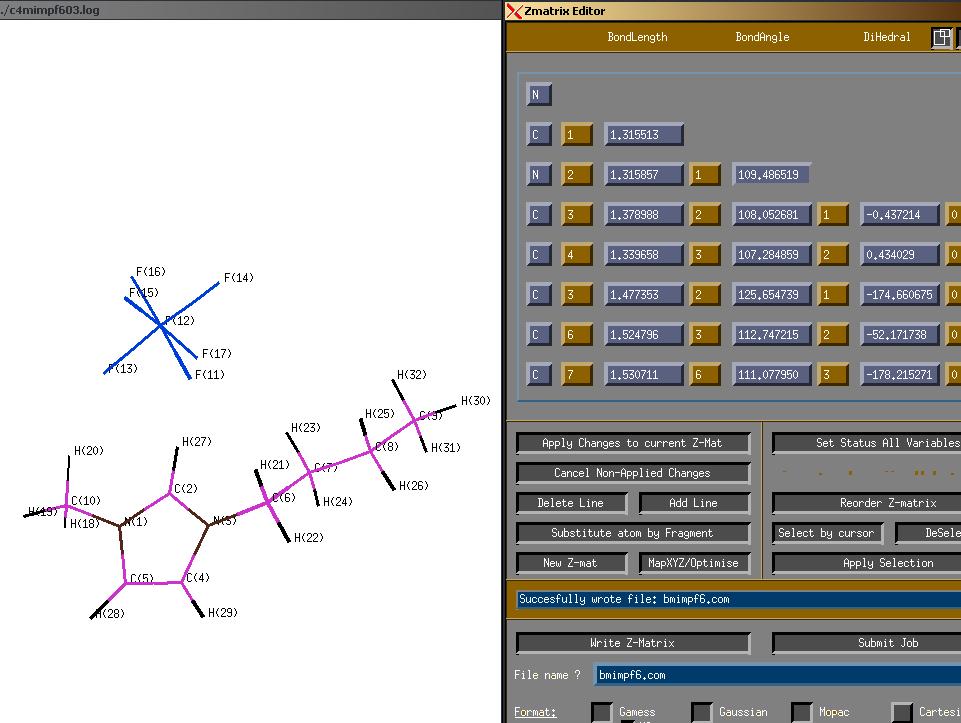
Figure 1.9 A screen shot of MOLDEN showing the final optimized [Bmim][PF6] structure and the partial Z-matrix
Frequency calculations were then done at the same level of theory using the same basis sets. No imaginary frequencies were observed that is no saddle points exist. So the obtained structure was a global minimum. The output file was viewed in MOLDEN and the final optimized structure is shown as a snapshot in Figure 1.9 along with the partial Z-matrix.
1.11 Results and Discussion
............The optimized geometry of [Bmim][PF6] is shown in Fig. 1.9. The coordinates for the optimized structure are presented in Table 1.2. The optimized bond lengths, angles and dihedrals are tabulated in Table 1.3. The total energy of this stable structure is HF=-1358.1174257 Hartree. This is in agreement with the results obtained (HF=-1358.117426 Hartree) in studies carried out by [Paulechka et al 2003]. The gas phase molecular structures of the ion pair [Bmim] and PF6- are stabilized by hydrogen bonds between the F atoms in anion and various H atoms on cation. This is in agreement with the results obtained by [Meng et al 2002]. [Shah et al 2002] carried out Monte Carlo simulations and reported that the highest probability of finding anion around the cation was around the C2 carbon atom. The C2 carbon atom (Fig 1.8) is the center of the largest positive charge on the anion, so this is where the anion localizes.