7.6 Radiation shield
Till now we have discussed about the radiative heat transfer from one surface to another without any interfering surface in between. Here we will discuss about an interfering shield in between, which is termed as radiation shield. A radiation shield is a barrier wall of low emissivity placed between two surfaces which reduce the radiation between the bodies. In fact, the radiation shield will put additional resistance to the radiative heat transfer between the surfaces as shown in fig.7.9.
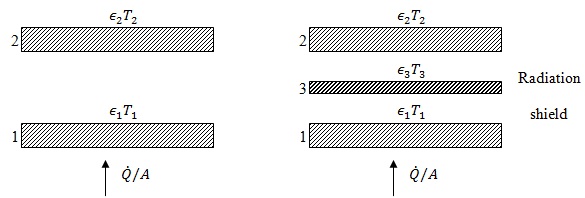
Fig. 7.9: Radiation between two large infinite plates (a) without and (b) with radiation shield
Considering fig.7.9(b) and the system is at steady state, and the surfaces are flat (Fij because each plate is in full view of the other). Moreover, the surface are large enough and  may be considered and the equivalent blackbody radiation energy may be written as Eb = σT4.
Thus, eq. 7.28 becomes
|
(7.29) |

In order to have a feel of the role of the radiation shield, consider that the emissivities of all the three surfaces are equal.

Then it can be seen that the heat flux is just one half of that which would be experienced if there were no shield present.
In similar line we can deduce that when n-shields are arranged between the two surfaces then,
|
(7.30) |

7.7 Electrical network for radiation through absorbing and transmitting medium
The previous discussions were based on the consideration that the heat transfer surfaces were separated by a completely transparent medium. However, in real situations the heat transfer medium absorbs as well as transmits. The examples of such medium are glass, plastic film, and various gases.
Consider two non-transmitting surfaces (same as in fig. 7.8) are separated by a transmitting and absorbing medium. The medium may be considered as a radiation shield which see themselves and others. If we distinguish the transparent medium by m and if the medium is non-reflective (say gas) then using Kirchhoff’s law,
|
(7.31) |

The energy leaving surface 1 which is transmitted through the medium and reaches the surface 2 is,

and that which leaves surface 2 and arrives at surface 1 is,

Therefore, the net exchange in the transmission process is therefore,

Using eq. 7.31,
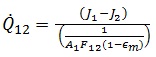
Thus the equivalent circuit diagram is shown in fig. 7.9
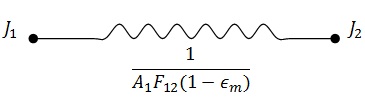
Fig. 7.9. Equivalent electrical circuit for radiation through gas